|
|
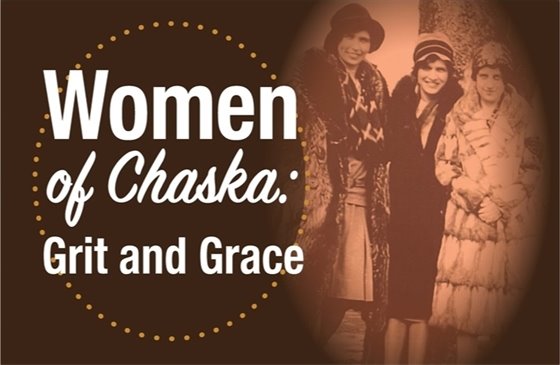
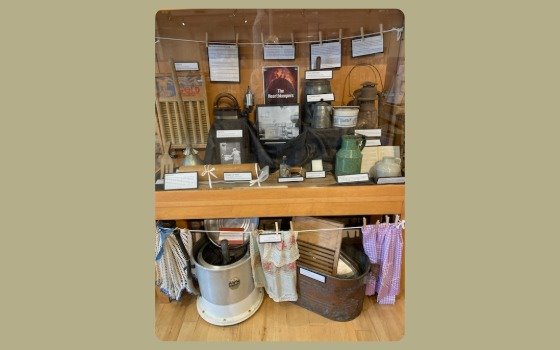
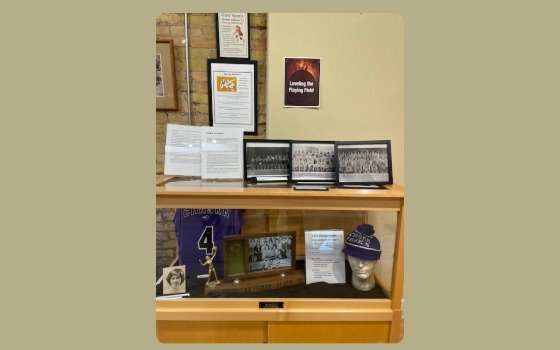
The 2025 Exhibit is Open!Visit the History Center to see the Women of Chaska:Grit and Grace exhibit. There is a wealth of information about the women in Chaska from 1850-2000. The exhibit addresses how women who may have had limited options began with education and eventually became business owners, entrepreneurs, politicians at local and state levels, organizers, artists and writers. They showed no limits on the opportunities they made use of. As you walk through the exhibit, begin with the Hearth Keepers. Would you have been able to cook, clean and maintain your home with the items shown? That roller is not a light tool! It was used to flatten a garment - really! |
|
|
|
|
|
Authors and Artists showcases talents that engaged their audience. See some of the creations of local women who were artists and authors. Another type of engagement was by business owners, maintaining a store or organizing charitable work in the community. Long time women-owned businesses in the community included the Baxter Store and Werner’s Photographic Studios. |
|
|
|
|
|
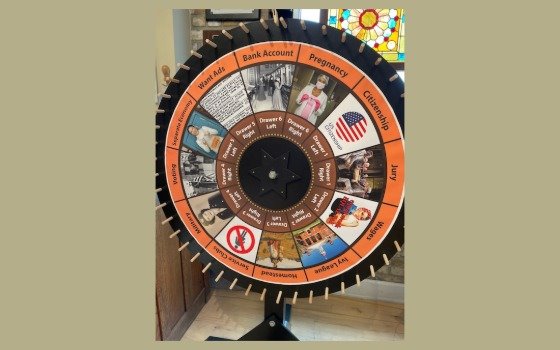
What rights did women have? Spin the wheel and check the results. We can guarantee you will be not only surprised but shocked in some instances. Did your knowledge match the actual data? |
|
|
|
|
|
Next on the tour - Title IX. What did it take for girls to participate in sports and how long before impactful results become viable? Check it out!! Can you add to the story? |
|
|
|
|
|
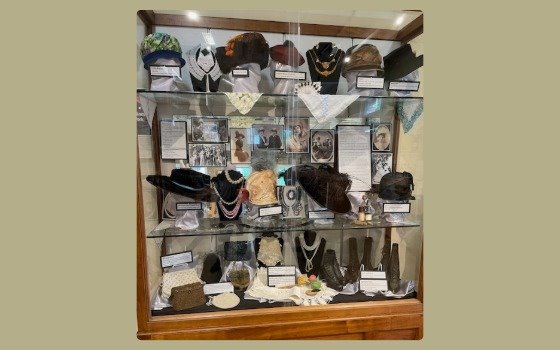
The best dressed woman always went out with a hat on. Some amazing hats for you to check out along with other accoutrements such as shoes, gloves and purses. Don’t those shoes look like ones we wore? Clothing styles certainly have changed. These fashionable dresses were de rigueur in their day. |
|
|
|
|
|
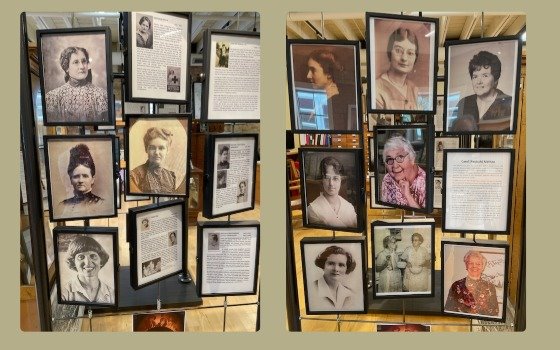
Teachers played a huge role in Chaska. Women had few options when they finished school - become a teacher or a nurse, or become a wife. You could not be a wife and have a career at the same time! Many of these women went on to better opportunities and becoming highly regarded in the community. Check out the Educators, Organizers and Politicians. Recognize anyone? Quilting has been around for generations. The quilts on display show great artistic talent and usage of fabrics and colors. One of these quilts is over 150 years old. Now that you have walked through the exhibit, what are your thoughts? Do you believe there are women missing who should be honored? Please give us their names. This exhibit will be up for two years so updates will occur. Thank you for visiting the Chaska Historical Center and the 2025 exhibit Women of Chaska: Grit and Grace. |
|
|
|
Let Me Tell You a StoryThe first mention I have in my notes was the September 19, 2015 board meeting minutes, under New Business, #8: New Volunteers: a. “Julie Wiese: Retired elementary school teacher willing to give presentations/activities for kids.” Julie started volunteering with us in 2015 with entering data into the database and staffing. She soon found that there were other things she preferred — and could bring her own magic to. One of those things was working with kids to make cornhusk dolls as well as having materials available for crafts during Hometown Holiday that year (2015). |
|
|
|
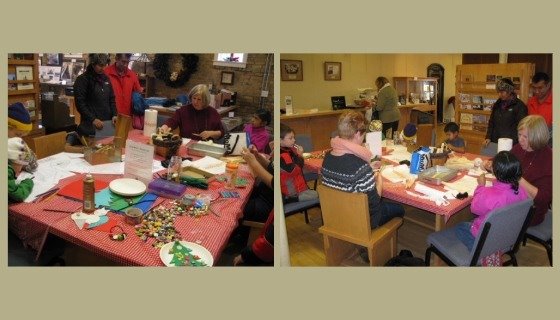 Left: Julie at the craft table at Hometown Holiday in 2015; Right: Julie helping kids make cornhusk dolls. |
|
|
|
Julie’s contributions quickly broadened to doing house histories; working with high school students; giving tours; creating displays; completing independent research projects; and more children’s activities (like “Playing with Grandpa and Grandma’s Toys”). |
|
|
|
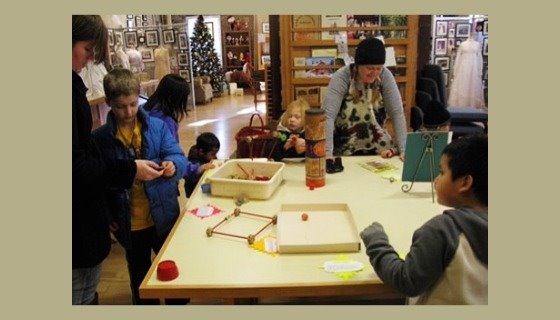 Kids playing with "Grandpa and Grandma's Toys". |
|
|
|
Fast-forward two years: September 12, 2017 board meeting. Under New Business: Added Julie to the board. Julie was at this time giving horse and wagon tours — she always made sure she knew the names of the horses — presentations to school and scouting groups; and took Jerry Lubansky around and interviewed him on video about places like Steinberger’s as well as on the homes throughout downtown (“Journeys with Jerry”). |
|
|
|
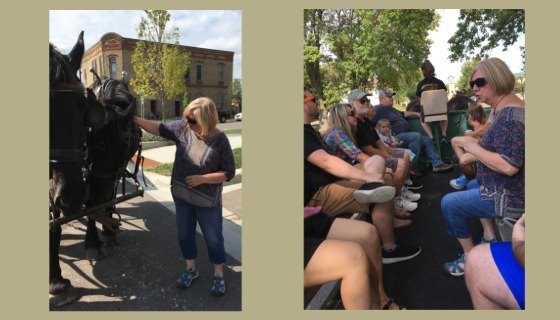 Left: Julie pets the horses in the horse and wagon tours. Right: Julie gives a tour from the wagon. |
|
|
|
By 2018, on top of some of those earlier activities, Julie was also doing cemetery research—with Connie Jacobs, a newer volunteer—and was integral in the 2018 Visioning process. She championed the need for increasing our visibility in order to build membership, supporters, and active volunteers. She took on the incredible responsibility of managing the Facebook presence, which, though we had had it since 2013, was little more than a membership for us. Julie learned how to grab people’s interest, get them talking, and single-handedly built our following to more than 2,000 followers. Julie was again involved with creating exhibits in 2019, when she played a large part in bringing the WWI and WWII in Chaska display to life. Along with these expanded responsibilities, Julie took on a co-sharing of the vice-president position with Carol Spalding. Covid-19 was a break for many, but not for Julie. She was busy researching—researching for the many people who sent us questions via Facebook or email, researching for the Heritage Columns themes and images that were begun at this time, and researching and writing historical Facebook posts and magazine articles and newsletter articles and more. Her definite talent and skill for making history interesting through the concept and power of story is remarkable! Julie’s child-centered focus will not be easily forgotten, either. She constantly and consistently brought the need for interactive and experiential experiences for the younger learners. The Lego Brick Building series is the last child-focused program she developed, this time with Marian Garrison Marlow. Instead of a “build as you want” free-time with the Legos, Julie took the time to figure out how to best utilize these tools to engage the kids in some of the traditional brick structures of Chaska, introducing them to the history and challenging the kids to recreate it themselves. |
|
|
|
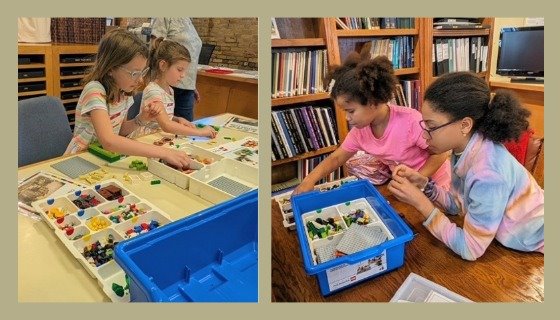 Kids taking part in the Lego Brick Building series. |
|
|
|
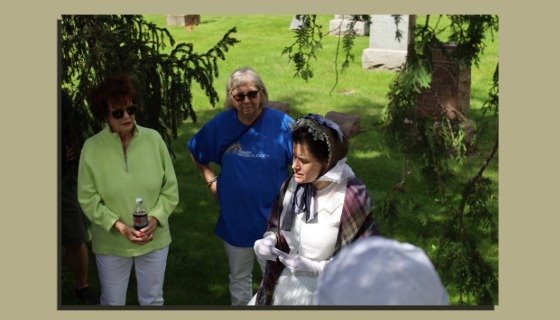
Perhaps the most amazing feat of this woman of many, many talents, came with her work with Connie Jacobs; they both can research, yes, and they both can tell a good tale, but the two of them together brought those notes to life in stories that captured the attentions of both young and old like none other. The “Hauntings and History” tours, the “What?! Murder and Mayhem in Chaska?!” tours, and the “Graveside Tales” re-enactments tantalized people with history they didn’t think they cared about, ultimately encouraging them to become involved in sharing that local history with others. Julie’s ability to listen to people’s interests and stories—and rewarding them with a story they hoped they’d find—was the most honest, sincere, truthful gift. It gave them what their hearts needed. |
|
|
|
|
|
|
|
In turn, through those historical events experiences, many participants inspired by Julie became volunteers at the historical society as well. It takes some time to learn the value of story, but, hopefully, they will have learned a little bit of that storytelling from Julie, and will, if they remember how tantalized they were, work to build their story sharing skills as well. Julie, we will miss you at the Center, and we wish you happy times with friends and family! |
|
|
|
|
|
|
|
Genealogists' Psalm 23From a Genealogy in Our Resource Center... Sometimes when you’re researching your family history, you stumble across little nuggets that make you smile. Here’s one that caught our eye: Genealogists’ Psalm 23: Genealogy is my pastime, I shall not stray
It maketh me to lie down and examine tombstones
It leadeth me into still courthouses
It restoreth my Ancestral Knowledge
It leadeth me in the paths of census records and ships’ passenger lists for my surnames’ sake
Yea, though I walk through the shadows of research libraries and microfilm reader
I shall fear no discouragement, for a strong urge is within me
The curiosity and motivation, they comforteth me
It demandeth preparation of storage space for the acquisition of countless documents
It anointest my head with burning midnight oil
My family group sheets runneth over
Surely, birth, marriage, and death dates shall follow me all the days of my life
And I shall dwell in the house of a family history-seeker forever. Rev. Erwin Albert Uecker (1932-2024) |
|
|
|
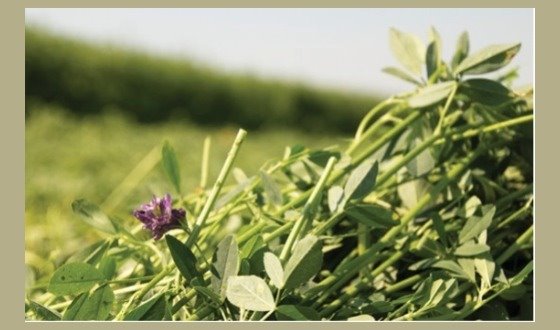 Alfalfa resembles clover, and most varieties have purple flowers. Grimm’s work made the Minnesota dairy industry possible. (Photo: Hay & Forage Grower magazine) |
|
|
|
Deep Roots in Chaska: Wendelin Grimm and Cold-Hardy AlfalfaBy Charles Pederson Alfalfa, a nutritious feed grass for farm animals, has become one of Minnesota’s most-planted crops. Originating in Persia, alfalfa has made possible the state’s dairy industry. This local success has come largely through the behind-the-scenes efforts of one man: Wendelin Grimm, a German immigrant to Chaska. Grimm spent his life quietly developing a winter-defying alfalfa—a major catalyst for today’s abundant crops. Though he labored in obscurity, he has earned his place as a pioneer of agriculture. The Alfalfa in the TrunkWendelin Grimm was born October 18, 1818, in a small village in central Germany, Külsheim (town slogan: “We have lots of springs!”). Like most people in his village, Grimm’s family farmed. Although the exact problem is unclear, local laws made it difficult for Grimm to inherit family land. So at age 40, he emigrated to the United States. Grimm left Külsheim with a large traveling trunk containing, among other things, a bag of about 20 pounds of local alfalfa seeds. Perhaps drawn by the already-resident German population, Grimm’s family traveled the 4,000-plus miles all the way to the Chaska area. |
|
|
|
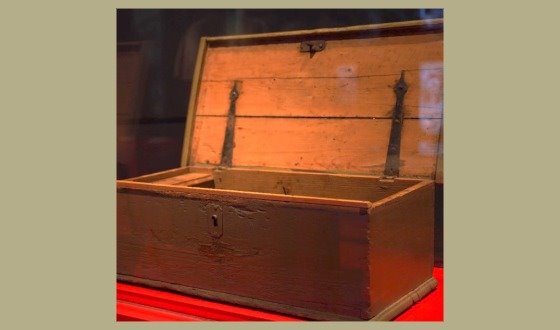 The original trunk in which Grimm brought his alfalfa seeds to Minnesota. (Photo: Carver County Historical Society) |
|
|
|
Grimm bought 140 acres of land north of Victoria, in what is now the Carver Park Reserve. He dug the seeds out of his traveling trunk and planted them. The Minnesota winter climate was much colder than winter in Külsheim, though surprisingly, Külsheim lies even farther north (50 degrees latitude) than Chaska (45 degrees). Thus, though the seeds sprouted and took root during the summer, many of the plants died from icy winter temperatures. |
|
|
|
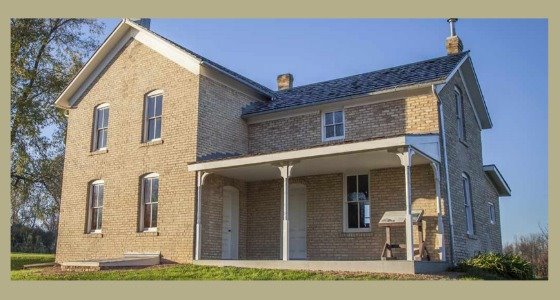 The original Wendelin Grimm farmhouse, made of beautiful Chaska brick. You can visit it at Carver Park Reserve north of Victoria. (Photo: Three Rivers Park District) |
|
|
|
German farmers commonly had used alfalfa as feed crop for farm animals. A perennial grass, alfalfa grows back year after year and still ranks as a top forage plant for animals. Typically, the crop can be harvested several times a year. A threshing machine, much like a large, old-timey lawn mower, could cut the grasslike plants, which would be dried and used as feed over the winter. Grimm alfalfa, like most varieties, has purple flowers that develop into seeds if the plants are left unharvested. The seeds can then be knocked from the grassy stalks, stored, and used to plant new fields of alfalfa. German alfalfa was fine for Germany but it was no match for winters in the northern United States. Nonetheless, Grimm gathered seeds from the remaining plants after every winter and replanted them. He made this his habit over the next several decades. |
|
|
|
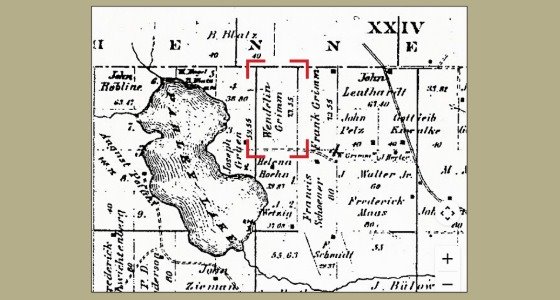 An 1880 plat map of Carver County shows Grimm’s farm parcel (top center in the map), located near Parley Lake, in what is now Carver Park Reserve. (Photo: Carver County Historical Society) |
|
|
|
The Ancient Roots of AlfalfaIn a 1977 article, researcher R. Clayton Brough and colleagues wrote, “Alfalfa appears to be the only forage crop which was cultivated before recorded history,” having originated thousands of years ago in the area of modern Iran and Turkey. Some dispute exists over how alfalfa first came to the United States, but until Grimm’s efforts, few could argue that alfalfa was hardy enough to withstand winters at a latitude north of Kansas. After several years, Grimm’s neighbors noticed that his farm animals were healthier than theirs and became interested in how he managed. George Du Toit, president of the Carver County Bank in Chaska, noted that Grimm “was a determined man . . . and kept at it until finally he won out and at last had a ‘Grimm strain’” of alfalfa that could take the cold. “Then gradually his neighbors followed him when they saw the great value of this [plant], and to-day you can scarcely find a farm in Carver County that doesn't have a field of alfalfa.” Cold as All Get-Out, but Not Quite Too ColdThe winter of 1874–1875 nearly ended Grimm’s experimentation. It was the coldest in Minnesota history. Long stretches of record subzero temperatures killed nearly all of Grimm’s alfalfa. U of M meteorologist Mark Seeley noted that “in the Twin Cities [that winter] there were 80 consecutive days where the temperature remained below freezing.” January and February 1875 still stand as the coldest months in Minnesota record books. Record snows, as much as 80 inches in some areas, also fell that winter. Du Toit told the story of talking with Grimm the spring after that frigid winter. Grimm explained that most of his previously planted alfalfa had been killed by the cold weather but, as Du Toit explained, Grimm “felt himself extremely fortunate to have saved a small bag of seed of a previous year's growth.” By that record winter, nearly 20 years after Grimm had begun conserving his seeds, enough had survived that Grimm was able to continue his experiment of creating cold-hardy alfalfa. In fact, Joseph Grimm, a son of Wendelin, remembered his family digging a new driveway through a field of alfalfa. The “roots of this clover had penetrated more than 10 feet deep through the clay soil.” Some root systems of 15 feet have been found. This might provide a clue as to why Grimm alfalfa was so resilient. |
|
|
|
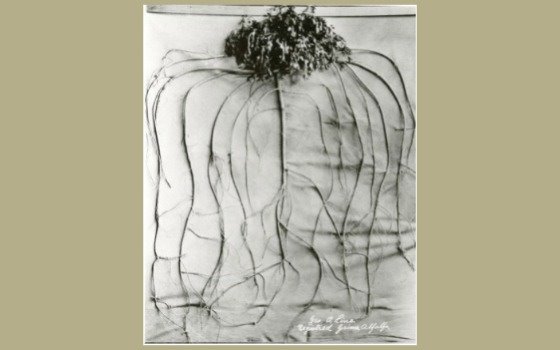 An 1894 photo shows a registered Grimm alfalfa plant with the bushy greenery that appears aboveground. The extensive root system could extend as much as 15 feet belowground. (Photo: Montana State University—Bozeman.) |
|
|
|
Twlight of the GrimmsGrimm eventually purchased a threshing machine to more efficiently harvest his alfalfa seeds and began to sell his excess. In one year, he was able to sell about 500 pounds of seeds for 50 cents a pound. Overall, however, he did not make much cash profit by selling his hardy seeds to neighbors. Much of any payment he did receive came in the form of food or other necessities in exchange for the seeds. Grimm retired in 1872 and moved to a farm plot at the edge of northern Chaska. This second farm, known today as the Kelzer Grimm Historical Farm, still exists (as does Grimm’s original house near Parley Lake). It lies on Pioneer Trail near Victoria Drive, across the road from Christ Victorious Lutheran Church. Though neither of Grimm’s farms is technically located in the city of Chaska, his legacy can be seen in the naming of the adjacent Clover Ridge neighborhood of Chaska. Grimm Road, also found in Clover Ridge, is named for Grimm. Grimm died in December 1890. His wife, Julianna, died in October 1897. Both are buried in the cemetery of Saint Victoria, the Roman Catholic church in Victoria. |
|
|
|
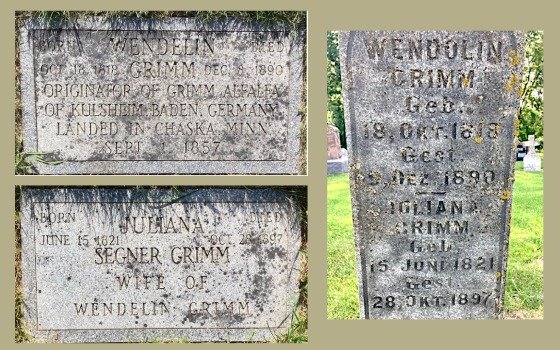 Wendelin and Julianna Grimm are buried at Saint Victoria church, in Victoria. (Photos: Charles Pederson) |
|
|
|
They Searched the World - but Found it in Chaska By the time of Grimm’s death in 1890, at age 72, Carver County produced nearly half of all alfalfa in Minnesota. Because, however, Grimm had done his work on his own and mainly for the local population, his alfalfa remained unknown widely. But during Grimm’s years of lonely work, researchers had been searching far and wide to find winter-safe alfalfa. School teacher Anthony Lyman was one of those searchers. His father worked a farm near Excelsior, and Lyman had become familiar with the crop. He brought the Grimm strain to a University of Minnesota researcher, Willet Hays, employed by the U of M Agricultural Experiment Station. Testing came to show that Grimm alfalfa was much more cold resistant than other strains of alfalfa. In fact, Lyman became so bullish on Grimm alfalfa that he built a whole farm and business around growing and selling it. He named the farm Alfalfadale. |
|
|
|
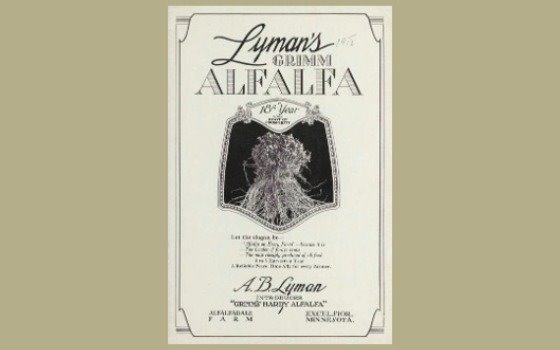 Lyman’s Alfalfadale released brochures extolling the virtues of the feed crop. (Photo: Alfalfadale Farm, in Internet Archive) |
|
|
|
One of Lyman’s efforts to promote Grimm alfalfa was to present a paper setting out its merits. Upon hearing the paper, one attendee, from the U.S. Department of Agriculture, gushed, “We have been searching the world” for a winter-resistant alfalfa. “We sent a man to Turkestan this summer at great expense to get something of that kind, but here [under our noses] we know we have what we sought.” Hays was able to extend governmental support for Grimm alfalfa when he joined the Department of Agriculture. The U of M’s Mary Hockenberry wrote, “In 1903 Grimm alfalfa was officially recognized by the U.S. Department of Agriculture and became the dominant strain” of U.S. alfalfa. |
|
|
|
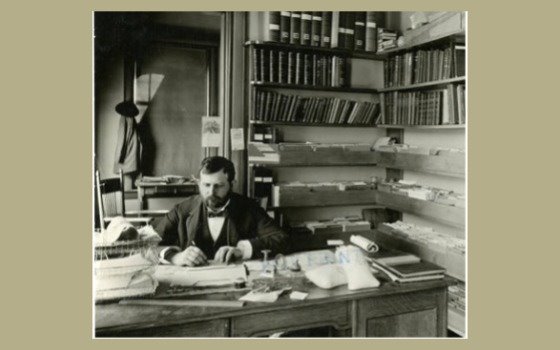 Willett Hays at work in his office at the Agricultural Experiment Station. (Photo: University of Minnesota Libraries) |
|
|
|
The Price of Obscurity, the Wealth of LegacyOver the decades, the value of Grimm alfalfa was proven over and over. As a means of recognizing Grimm’s achievement, in 1924, the Grimm Alfalfa Growers Associations placed a memorial plaque at the original Grimm homestead. In 1974, the building itself was entered in the National Register of Historic Places. In recent decades, Grimm alfalfa—the basis of most modern varieties of the crop—has been valued nationally at $10 billion per year. In 2011 Hockenberry and colleagues ranked Minnesota sixth in national alfalfa production, though alfalfa production has decreased somewhat since then. Historians Everett Edwards and Horace Russell summarized Grimm’s work in 1938. “The production of a forage plant so hardy as Grimm alfalfa, with its permanence, enormous yields, high protein content, economy as a crop, and value as a soil builder and weed throttler, is almost without parallel in plant history. It is impossible to compute in dollars and cents what it has meant to the nation.” Such national importance belies Grimm’s humble work. George Kelley, journal editor and a speaker at the memorial dedication, stated that “sometimes [fame] is given to ... a patient man or woman who in obscurity and perhaps in poverty has worked out great benefits to humanity.” |
|
|
|
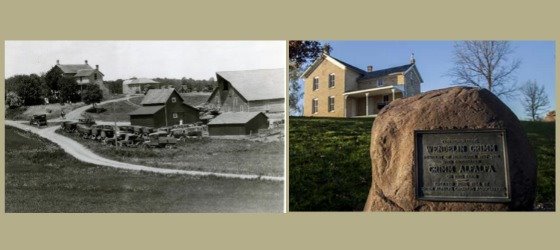 The Grimm homestead in 1924 (left), at the dedication of a memorial marker (right) provided by the Grimm Alfalfa Growers Associations. (Photos: University of Minnesota Libraries [left]; Three Rivers Park District) |
|
|
|
Learn more!- Brand, Charles J. (1911). Grimm Alfalfa and Its Utilization in the Northwest. Government Printing Office.
- Brough, R. Clayton, Robison, Laren R., & Jackson, Richard H. (1977). The Historical Diffusion of Alfalfa. Journal of Agronomic Education, 6(1), 13–19.
- Carver County Historical Society. (n.d.) Wendelin Grimm, 1818–1890. https://www.carvercountyhistoricalsociety.org/notable_people.php
- Edwards, Everett E., & Russell, Horace H. (1938, March). Wendelin Grimm and Alfalfa. Minnesota History, 19(1), 21–33. In JSTOR.
- Gould, Heidi. (2013). Grimm, Wendelin (1818–1890). MNopedia.
- Hockenberry Meyer, Mary, and Davis Price, Susan. (2017). Alfalfa. In Ten Plants That Changed Minnesota. Minnesota Historical Society Press.
- Seeley, Mark. (2025, January 3). Coldest and Warmest Years in Minnesota Separated by 150 Years [Blog post]. Minnesota Weather Talk.
- Three Rivers Park District. (n.d.). Grimm Farm Historic Site.
- Weddle, C. J. (2020, November 16). From a Small Bag of Seed. Hay & Forage Grower. https://hayandforage.com/article-3264-from-a-small-bag-of-seed.html
|
|
|
|
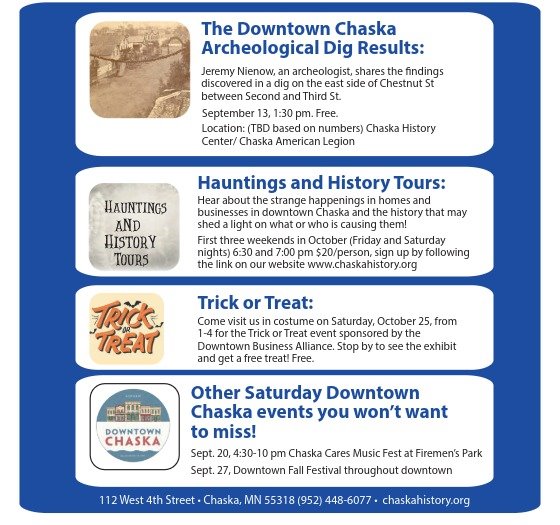
Archaeology Talk: Chaska Ess PropertyBy Dorie Coghill Celebrate Minnesota Archaeology Month with a presentation by Dr. Jeremy Nienow of Nienow Cultural Consultants LLC on Saturday, September 13 at 1:30 p.m. at the Chaska History Center. Jeremy Nienow, PhD., RPA, is a registered, professional archaeologist with 30 years of archaeological experience including 20 years meeting the Secretary of Interior's standards for archaeology. View the full article from the Carver County Historical Society’s Summer Newsletter “Transcending Time.” The article and event will give you a perspective on what was found during the archaeology dig at the Ess Property, but I thought I would give you a little more information on the family and the buildings themselves, as I grew up on that block of Walnut Street. The Ess family immigrated from Germany to the US in 1852 and settled in Chaska in 1854. Joseph Ess was originally a wagon maker. He started the Ess Foundry in 1867 on the SE corner of Walnut and East 3rd streets at the urging of the brick yard owners as they needed machinery for use at the brick yards. Over the years they acquired several pieces of property for businesses and housing on both sides of Walnut Street, just south of East 3rd Street. |
|
|
|
|
|
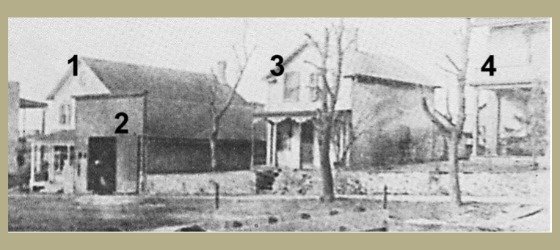
The 1890’s Photo is showing the west side of Walnut Street. The Wolff House (#1) was built in 1880. 211 Walnut (#3) was built in 1865 with a Farm Implement store (#2) beside it. 217 Walnut (4) was built in the early 1880’s. Both 211 and 217 underwent many major structural changes in the years before they were torn down. #1) The Wolff house was occupied by the Wolff family with an upstairs apartment used as a rental. That apartment also housed Ess family members over the years. #2 and 3) The original Farm Implement building was eventually torn down and a garage was built in back of the structure pictured with the driveway to the garage occupying the former building footprint. We think that at the same time the front door of the 211 house was moved to the side and a porch added over the new front door with the steps coming down to the sidewalk at the end of the driveway. When the Riedele house was moved from Fireman’s Park to this spot the move was done at night and they did not want to try and put the house in place in the dark so they left it sitting the middle of the intersection on Walnut and East 3rd Streets. Clear Soft Water is located at the South West corner of that intersection and the following week they put an ad in the Chaska Herald with a picture of the house sitting in the middle of the intersection and a caption saying “We make house calls, you do not have to come to us”. #4) The house was built in the early 1880’s by Joseph Ess as a two-story single-family home in a T shape with a partial basement with walls made out of large boulders. It had foot thick brick walls which at some point were covered with stucco. Josephine Ess was the first one to be born in the new brick house in 1883. When Wally and Lil Ess bought the house in 1947 they added a family room on the back side of the house along with electricity and plumbing and moved the kitchen from the front of the house to the back of the house. The boulders in the basement walls were also reinforced with concrete and the basement enlarged to the entire footprint of house. The city has no record of locations of wells or cisterns, but the Sanborn maps do show locations of the outhouses. They also converted the second floor into an apartment for one of the Ess Foundry workers and his family. The access to the second floor was a stairway that exited the front of the house just to the right of the porch. In the mid 1950's the upstairs family moved out and to accommodate his growing family Wally took out the stairway and closed off the outside door and made the room into a bedroom. He converted the upstairs into two apartments with a covered porch and added stairway access to the apartments on the south side of the house. Wally was a volunteer fireman from 1946-1976 including 15 years as Fire Chief. The Fire station was in the building on East 3rd street that is now Von Hanson’s Meats - so in Wally's back yard. The kitchen in the 217 house had two phones - one a house phone and the other a Fire Dept phone. If someone called in a fire or other emergency that phone rang and Lil took down the info and activated the siren on the fire hall that notified all of the volunteers to come and help. Many of them worked in or near downtown Chaska, so you knew when you heard the sirens to get out of the way of the men running or driving to the fire station. We have been told by a former baby sitter that they were forbidden to touch the Fire Dept phone. The front porch was covered sometime in the 1960-70's. It was the only house in town where the rain runoff from the gutters went underground out to the street. When my husband and I bought the 217 property for use as rental property we had the lot surveyed and found that the 217 sidewalk and retaining wall were on the 211 property. But no one cared when the houses were built as both lots were owned by family. The 217 house was destroyed by fire in 2014 and torn down in 2017. |
|
|
|
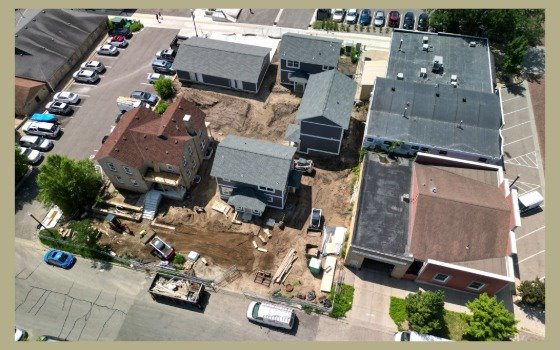 Aerial view of the Ess lot taken in July 2025. The historic Ernst house is being renovated, and 3 new houses are being built as a part of the Chaska Yards development. |
|
|
|
|
|
|
|
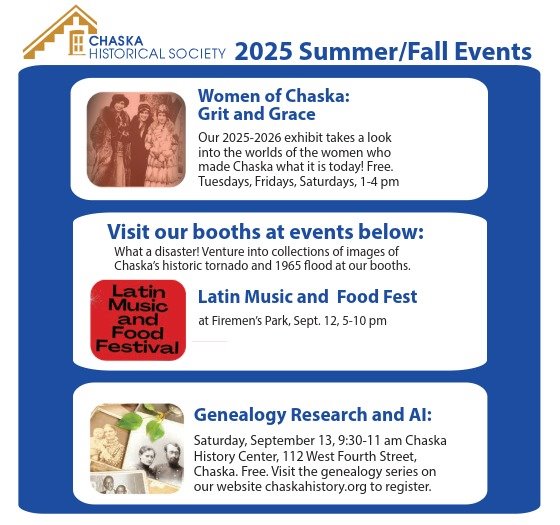
Beyond the Basics: AI-Powered Genelogy ResearchExplore how free AI tools can enhance your family history research. This session will show you how to ask better questions, discover new leads, and gain historical context about your ancestors' lives using cutting-edge technology. Presented by the Chaska Historical Society
Saturday, September 13, 2025 · 9:30 AM – 11:00 AM Chaska History Center · Free event · Space is limited |
|
|
|
|
|
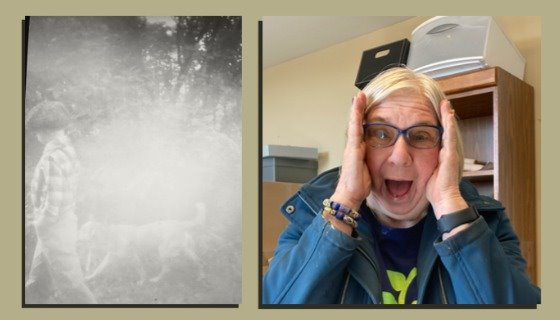
Hauntings and History ToursThis October, as the autumn air cools and the leaves crunch underfoot, join us for an unforgettable evening exploring the historical past of downtown Chaska and some of the ghostly residents who may still be residing there. Our popular Hauntings and History walking tours return for six nights of stories, shadows and the sounds of footsteps in the night. Held on Friday and Saturday evenings during the first three weekends of October, tours begin at 6:30 p.m. and 7:00 p.m., and last approximately 90 minutes. Each walk is under a mile, lit by lantern glow, and steeped in tales from Chaska’ s rich past. Hear about the historic homes and business buildings that have stood the test of time… and possibly play host to spirits who never left. These tours are family friendly, though younger children should be prepared to listen closely and have an interest in history - this is more storytelling than scares. Most our ghosts are friendly with a few grumpy ones. Registration is required, and space is limited - so don’t wait! Visit our website to sign up and reserve your spot for a unique night of local lore and haunted history. Dress for the weather, bring your curiosity, and prepare to see Chaska in a whole new light. Or lack thereof. See you in the shadows! |
|
|
|
|
|
|
|
|
|
|
|