Chaska Historical Society
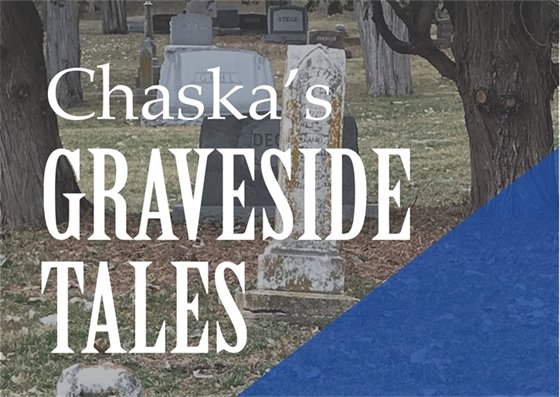
Chaska Graveside Tales with gravestones in the background

Graveside Tales Tour

Do you like to think about what life was like in the past? When you drive past a cemetery or wander through one, do you ever wonder who these people were? Would you like to meet some of these folks and hear their stories? 

Learn what it was like to settle the frontier in those early Chaska days. You may be surprised at some challenges they had; but also their joys.

The Chaska History Center is sponsoring a new Graveside Tales Tour at Guardian Angels Cemetery. Reenactors from the Minnesota Living History Society will portray some of those early settlers who have passed on and share their stories. This tour is for adults only (18+), please no children. There will be time for questions and answers at the end of the tour.

The tour involves navigating hills and very uneven ground. We will meet at the lower level of Guardian Angels Cemetery. The cemetery is located off Big Woods Dr. ( County Rd. 44. northwest of Chaska) In case of light rain the tour will go on. If the weather becomes severe, the tour/ reenactment will move to the Chaska History Center, 112 Fourth St. West.

The date of the tour is June 28, 2025. Cost is $25 (no refunds).

Times:

  • 10:15 a.m. - Noon (Please meet at the lower level of the cemetery at 10:15 a.m.)
  • 1:15 p.m. - 3 p.m. (Please meet at the lower level of the cemetery at 1:15 p.m.)

Sign up for a tour!

Painting of Chaska Farm and Garden

Chaska Farm and Garden, by Emily Anderson, 1993. (Photo: CFG Facebook page)

Gardening Season - Remembering Chaska Farm & Garden

By Charles Pederson

A cornerstone of the Chaska community closed about 15 years ago — Chaska Farm and Garden. Though long out of business, it lives on in Chaskans’ hearts, affecting all who knew its gentle care for plants and people alike. With the return of the spring gardening season, a brief look back at a staple of Chaska gardening is in order.

Moving Around, Settling In

Chaska Farm and Garden got its start in early 1981. That year, partners Tom Hayden, Tim Kenny, and Julie Alden moved from the Minneapolis area to Chaska. Their big idea was to start a small business serving local gardeners. All three had degrees in horticulture and were interested in putting their knowledge into practice. Hayden recalled that “we were mostly overeducated” for the work. One employee, for instance, “paid for his own degree at Saint Thomas for a business degree, but still came back [to work in our little shop]. Often we talked more history, science, and politics than anything.”

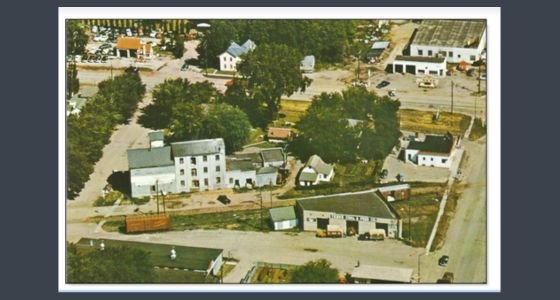
The garden store first settled into the brick building that was part of the Teske Coal and Feed Company along West Fifth Street. The company consisted primarily of the classic tall building where feed and grain were stored for shipping (now called The Mill, housing a restaurant and other small businesses) and a low, triangular building on the same block, at the corner of Chestnut and West Fifth. The building had three bays that had stored coal. After Teske sold the building, “it had been a feed and farm hardware store,” said Hayden. “We inherited a large amount of small hardware” that was gradually gotten rid of during sidewalk sales. The building today houses a clothing consignment store.

Aerial view of the Teske Coal and Feed Company. The Chaska Farm and Garden is the brick building at bottom right.

Teske Coal and Feed Company was housed in the tall white building at left. An early incarnation of Chaska Farm and Garden was located in the brick building with the triangular roof at bottom right. (Photo: Chaska Historical Society)

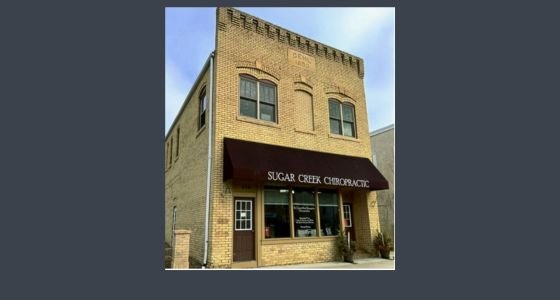
In 1983, the store was moved into the old Gehl’s market building at 122 West Second Street. Hayden appreciated the ambience. He told the Chaska Herald at the time that customers had “good memories of the building from when they came here to get food out of the old [frozen meat] lockers.” Hayden and his partners restored the store, but “the location was poor,” according to Hayden, and it was time to move again.

Sugar Creek Chiropractic, which was the Gehl building

Through the door to the right of the plate-glass windows, Hayden’s store had an early incarnation. (Photo: Chaska Historical Society)

In 1985 — this time on his own (his partners having split off) — Hayden moved the business into an old A&W stand at the corner of Chestnut Street (Highway 41) and Highway 212 (today Chaska Boulevard/County Road 61), next to Firemen’s Park. The location had more outdoor space and lots of traffic. His customers were serious gardeners, “mostly the Greatest Generation and older Baby Boomers,” stated Hayden. Along with horticultural products, he also sold Iams and Science Diet specialty dog foods, which at the time were not widely available.

Not only horticultural supplies were on offer but also recipes. Hayden posted the following on the store’s Facebook page in February 2011:

“Sounds bizarre but gets rave reviews! I use a handful of needles chopped very finely, along with the grated rind of one tangerine, put into about 4 ounces of good olive oil. Let stand in a warm place, even a 180-degree oven, for several hours to infuse and then strain out the solids. Drizzle about a teaspoon of the oil over a good vanilla ice cream. Top with a teaspoon of pan-roasted pine nuts and a pinch of coarse sea salt and serve with a lemon wafer or sugar cookie (not vanilla). Note: I used needles from a white fir, Abies concolor, but balsam fir or Fraser fir should work the same, likely pines too. Refrigerate infused oils, for extended storage.”

Kitchen utensils on display

(Photo: Chaska Farm and Garden Facebook page)

Hurdles and Barriers

Business hummed along until events converged. The Great Recession of 2008 wrecked not only the global economy but also that of the small garden store. At the same time, the Highway 212 bypass opened north of town, siphoning off much of the serendipitous traffic that had often turned into paying customers. Finally, customer demographics changed, and people began to spend their money elsewhere.

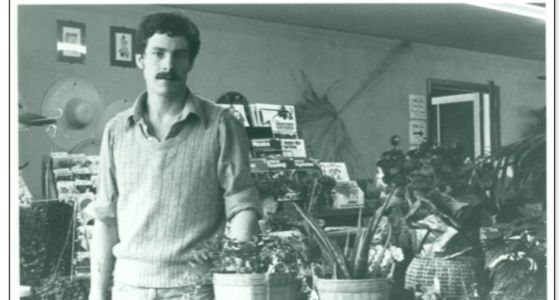
Tom Hayden, owner of Chaska Farm and Garden, standing next to plants

Tom Hayden, hard at work in the shop, 1981. (Photo: Chaska Historical Society)

No doubt some confusion was added in 2009 when the city of Chaska wanted to clean up hazardous waste in the soil left by an auto body shop and a gas station that had also occupied the site. The shop was moved briefly off the site in fall 2009, returning by the next summer. Although business rebounded briefly, it dropped again, compounded by aftereffects of the Great Recession and changing demographics. Hayden reflected that “people by then weren't so much hobbyists in the emerging generation, wives/mothers had gone to work, the big boxes got serious about competing. . . . Also I was 58 and wasn’t up for the risk.”

Rows of plants for sale in the Garden Center

The garden center offered a wide range of beautiful plants. (Photos: Chaska Farm and Garden Facebook page)

Finally, Hayden was forced to conclude that the economics of the business would not improve. In mid-2011, he announced that Chaska Farm and Garden would be closed by the end of the year. The staff members were prepared for strong emotions. “We’ll have to put out a box of Kleenex” for all the customer and employee tears, said longtime employee Kevin May.

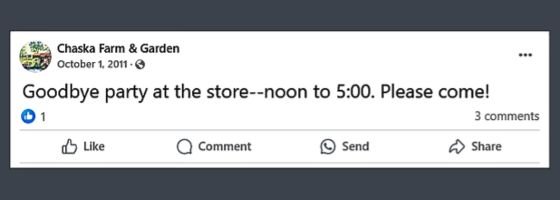
The last Facebook post from Hayden was addressed to the community.

Chaska Farm and Garden last Facebook post about a goodbye party at the store

(Photo: Chaska Farm and Garden Facebook page)

Making Memories, Cementing Loyalty

The little store had long and happily served the needs of the Chaska gardening community, with an emphasis on personal customer service, while creating many happy memories. Hayden’s store provided a wide array of plants and other items.

But it’s the feeling that many people remember. One Chaskan recalled “the cozy small-town feeling of shopping while being hugged by the canopy of trees” and especially “the little metal goats they would move around [the property]. I would drive by with my kids and we couldn’t wait to see where the goats were that week.” Another local resident appreciated “the staff and Tom, who made the place so special. Tom's mustache was so much like Magnum PI! I remember how knowledgeable everyone was and easy to offer ideas for gifts and landscaping.”

Ashley Fox, a summer employee for several years, said, “I was known as Morticia (Addams), by the owner, as I loved deadheading [pulling dead blooms from the plants]. Sometimes a little too much to the point where none of the roses had full blooms anymore. A lesson I quickly realized if you wanted to sell expensive rose bushes: Leave the blooms on those roses!”

Metal goats on display in the garden center

The little metal goats were a popular feature on the grounds of Chaska Farm and Garden. (Photo: Chaska Farm and Garden Facebook page)

Several locals held jobs at the store. Kevin May, a longtime employee, worked there for 25 years. “It was a high school job that I never left.” Later he became manager, a position he held until the business closed. “I will always be indebted to him,” Hayden commented.

Hayden is particularly proud of Ashley Fox. Starting in 1994, Fox worked six years at the store during summer holidays. She recalled that “the summers working there were a gift, and I will never forget them.”

According to Hayden, Fox became “a wedding florist and an elite one,” winning several Twin Cities awards and keynoting the 2025 Minneapolis Institute of Art (MIA) “Art in Bloom” show. Fox reciprocated Hayden’s fond feelings: “[He] shaped my career path, and I am forever grateful. Also, he is one of the most kind, funny, knowledgeable, and creative people I know. It is an honor to know him. You have to love the man who brought flowers and joy to so many people all those years. I'm sure there are thousands of gardens out there with plants from CFG still growing in them. What a legacy.”

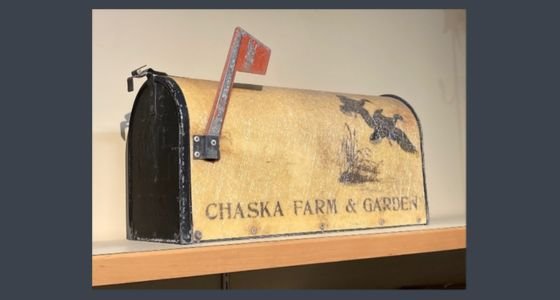
Mailbox with Chaska Farm and Garden on the side

(Photo: Charles Pederson)

Learn more!

  • Chaska Farm & Garden. (n.d.) [Facebook page].
  • Francisco, Mollee. (2011, August 25). Chaska Farm & Garden to Close. Chaska Herald, in Southwest News Media.
  • Olson, Mark. (2009, November 12). Chaska Farm & Garden Moving—a Little. Chaska Herald, in Southwest News Media.
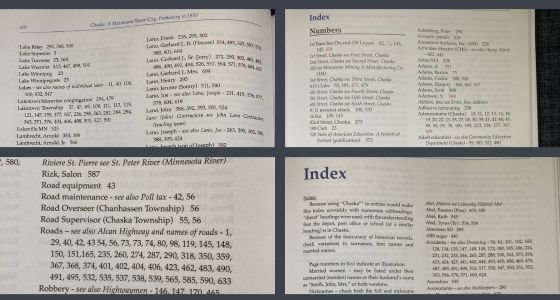
Different views of the index in the Chaska History Book

Indexing, Thoughts On

By Marilyn Savelkoul Gahm

EDITOR'S NOTE: Marilyn was the indexer of the original two-volume Chaska history books, plus Volume I and Volume II, of the Chaska Historical Society, and the Andrew Peterson diaries published by the Carver County Historical Society – plus more books and magazines.

Making an index to a book or magazine creates a bridge – or translation - between the mind and language of an author and the needs of the reader/user.

In library school, I learned that a reference book without an index was considered useless. No index = no easy access to the information in the book, making it difficult or impossible to find. Today, with online digital books, you can search a specific word – but often not complex meanings or spelling variations, and you’d miss a reference to your person of interest when the reference was to “she” (who?). 

The indexer’s job is to interpret the writer’s language into the reader’s language. An indexer is always balancing between “what did the writer mean?” and “how is a reader going to approach this?”

It is easy enough to prepare a name index to a book, you might think. “Smith, John” – easy, right? Not so much for historical books, which may use original sources – and their original (faulty?) spellings. Is “John Smith” also Jake Smith, Jack Smith, John S. Smith, J.S. Smith, John Smithe, John Smythe, John Smith Sr. or John Smith Jr.?  In addition to the variations caused by original and incorrect print sources, name variations escalate when the additional challenge of reading “old (or any) handwriting” is added. 

The form of a personal name is a challenge. Sometimes after the final whittling down is done, there are still some name versions that cannot be verified, so your index may include “Smith, John” and “Smith, Jack” – who may be the same person.

Names of entities – Klein Bancorporation, Klein Bank, KleinBank – can also vary over time, and between sources. And which City Hall or County Courthouse location in Chaska did you mean?

Another challenge is the question of “too much vs. too little.” With what level of detail do you challenge a reader?  Do your subject headings need subheads or clarification? Volume II of Chaska history covered a lot about sports – at the local schools (Chaska/Guardian Angels), plus recreational leagues, sports venues and professional teams. An index entry like “Baseball” would have produced a lengthy string of page numbers. An index user would have faced the lengthy task of looking up each page entry in the book to see if it was useful. Subdividing Baseball into headings like “Baseball (Chaska High School boys)” significantly decreased a reader’s pain – while increasing the indexer’s work.

Even after reading the text beforehand, I have never failed – some pages into a book – to realize that I was under-indexing (too broad) some topics and over-indexing (too narrow) others. Ah, start over! Decide on a different level of detail and review my work. Sometimes this enlightening occurs at the very end. Is there way too much subdivision of a term used only a few times? The final index is a balance between condensing into less and differentiating more.

Then the “guilt trip.” An indexer knows if a term is missed, it is lost FOREVER. I know I’ve made errors in the 30+ books I indexed, but I sure tried hard not to, because of this responsibility.

Before computers, I indexed using the appropriately named 3x5 “index cards.” That was painstaking. Each entry got a card (handwritten subject, subhead, page), the cards were sorted alphabetically, then condensed (sometimes discarding subheadings), then typed. More room for error, more time at the end of the index process sorting cards and determining headings. And losing even one card? – lost forever.

Once computers were available, I used the Excel program to index. Excel sorts entries alphabetically, and automatically begins to fill in the header in a column, although you do have to retype the numerous page references to, say, the “clayholes” onto one line if you don’t want to keep the index in its original Excel table format. As you can guess, I index “as I go” – making subject headings and page notes for each entry as I read it, then sorting and consolidating entries at the end, rather than searching back into an Excel file to find where the term was used previously and adding a page reference. With a lengthy book, that process would take months! You can also create a table in the Word program, and sort it.

Professional computer indexing programs are available, but I get by with Excel, although the final product usually has to be converted into a more easily read format. Of course, you can – and I have – kept some indexes in their original Excel table format. Or you can try a Word table format.

An interpretation/translation requirement is the use of “see” and “see also” references. Not only is an indexer translating a writer to a reader, but you the user cannot read the mind of the indexer, so my mind must be made accessible to you.  

A “see” reference (or several of them) sends a user from a term the user thinks is a good starting point to the term the indexer chose to use. If you remember Chaska had a drum and bugle corps, you look up “drum & bugle corps.” The “see” reference sends you to the names of the two musical units that existed in Chaska. And what was the name of the “pickle factory?”  I tell you to see M.A. Gedney Co. And if you looked up “Gedney,” you’d have been directed to the official name of M.A. Gedney. 

Did I use First Ward or Ward 1 for a Chaska political division? The “see” reference will tell you.

Perhaps you look up “Parks” in the index, where you find a “see also” reference to the names of 28 parks and Chaska’s Parks and Recreation Department. It would have been a disservice to a reader to type an enormous list of page references for all those parks into one list, so separate park headings were made. But since you the reader cannot know all the parks that existed in Chaska, the indexer jumps in to help you. 

In a book devoted to a single topic, like Chaska, it’s best to avoid beginning headings with that word. Which is why you’ll find the Chaska Parks and Recreation Department under “Parks and Recreation Department.”

An indexer needs the talent to think in “subject headings” – and in reverse. I chuckled – and groaned with dismay – when I consulted the index of a book on starting a restaurant. The restaurant book index failed the reader when it used the subject heading “Making a menu” instead of “Menu, making a.” Who looks up “making”? 

When I indexed several monthly Twin Cities business magazines for several years, I needed a way to keep myself consistent over time so I created a subject heading list. The list consisted of “see” and ”see also” references, and the subject heading I had chosen to use. After I had jotted down subject headings and pages in a computer file, I would look up each heading in this list, to see if that was the previously used term, or if I had forgotten and chosen the “wrong” subject. If you index a recurring publication, I recommend a master referral list. When I indexed Volume II for the Chaska Historical Society, I referred to Volume I for the headings – and “see”/”see also” references I used previously. One caution: language changes over time, so you may need to adjust your subject headings, and add more “see” and “see also” references to accommodate terminology changes or language that has become unacceptable in society. You may wish to “shut down” a subject heading, and add a note like “Heading [used through 2023]” and “Heading [used 2024 and following],”

Making an index is often hard, frustrating, time-consuming – but oh! so all worth it, when an indexer delivers a product that opens the door to a wealth of information.

After writing this article, I found an article titled “The Pleasures That Lurk in the Back of the Book” by Alexandra Horowitz, published in The Atlantic of March 16, 2022. Always nice to find someone who agrees with you! The author is an admitted lover of “the humble index – expediter of searches, organizer of concepts.” She wrote: “Indexes offer the reader multiple ways in and through the text.” Horowitz references a book by Dennis Duncan with a clever title: Index, A History Of the – and noted: “The history of indexes, as Duncan tells it, is also a history of alphabetical order, chaptering, and the advent of page numbers.”  Found it fascinating that page numbers were only introduced in a 15th-century printed book. (Can’t index without ‘em! – although I have more than once been asked by a publisher to index a book BEFORE the page numbers were assigned. Sorry, “no.”). 

An author herself, Horowitz wrote, “After the manuscript is completed comes a thrilling day when I am sent my own book’s index – the person who compiles it is the first reader who isn’t invested in the book. The topics she pulls out, how she cuts the conceptual lines, are more than a concordance of words; they are her interpretation of the landscape of ideas in the book.” 

I like the image of an indexer as a tour guide of a book’s landscape.

Carrie Drephal looking at a person with index shelves behind her

Volunteer Spotlight: 

Carrie Drephal

Always on the lookout for volunteers to come and join us at the Chaska History Center, we were especially blessed when Carrie Drephal showed up at our door, bringing skills very much appreciated at our organization.  Carrie is an experienced genealogist and skilled in computer and graphic arts applications.

Carrie grew up a farm girl near Wrightstown, Wisconsin on land pioneered by her family since in 1894.  Genealogy entered her life when she began to research her colorful ancestors.  Apparently, Grandma was a bootlegger during Prohibition!  In later years, Carrie would be a volunteer for the Brown County Library in Green Bay, teaching Dutch and German genealogy.

College at UW-Platteville took her away from the farm, with her earning a degree in Communication Technologies Management. After graduating, she packed up her degree and all her belongings and took a train to New York City where she interned at Artemis Records, promoting various heavy metal bands to radio stations across the country. 

She would later travel to the West Coast, San Diego, where she had been hired by e-music.com, working in the licensing department, doing online investigation of the legal licensure required to place songs on the website. It was during this time that Carrie started her own part-time business. She now builds and designs websites full-time. 

Have you ever watched a TV show called “The Dead Files” on the Travel Channel?  Perhaps you saw the two episodes featuring Carrie, where she used her genealogy resources to provide details of owners whose property experienced paranormal activities. 

Carrie settled in Chaska in 2018, coming with her boyfriend and finding the business climate conducive to their careers. She also has a woodworking business called “Fetching Woodworks”, which can be found online. 

It was the Chaska History Center’s tour of the town’s less respectable history, “Murder and Mayhem”, that brought Carrie to our door.  She is now teaching genealogy classes at the center.  Carrie says it is the community of people at the Chaska History Center that keeps her tied to the organization.  She is also enjoying learning the history of Chaska.  

Upcoming Genealogy Series Dates:

  • June 5, 6:30-8:00 pm: Heroes Among Us: Tracing Family Military History
  • July 17, 6:30-8:00 pm: Digital Discoveries: Navigating Online Genealogy Resources
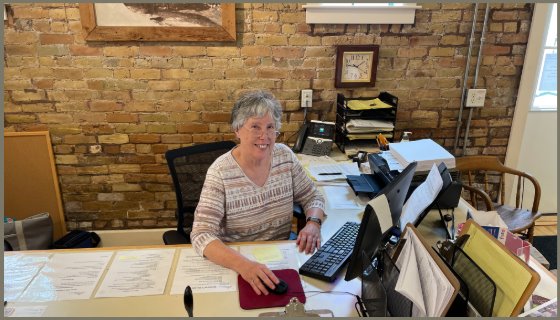
History Center volunteer sitting at welcome desk

Research Help Available at Chaska History Center

By Dorie Coghill

Did you know you could call or visit the History Center and get answers to questions concerning Chaska and/or Chaska Families history?

We have a library of family genealogy books, newspapers dating back to the 1860s and 10,000+ photos—plus knowledgeable volunteers ready to assist. In the past couple of months we have helped with the following:

  • The Ess foundry is now located in Loretto, MN.  They were doing a remodel of their office and asked if we had any photos they did not have so they could display them in their new office.  They came and looked an what we had and we sent them a CD with digital photos.
  • Chaska Place Apartments was looking for photos that they could enlarge and place in their hallways.  They came to visit and picked out more than a dozen Chaska Historical photos that they will enlarge and frame.
  • We had a request for dates and pictures of when the Arby's and McDonalds opened.  We had inside pictures of opening day at the McDonalds and an outside picture of the Arby's.
  • We had a request for historical info and pictures of Cy's Bar from one of their employees.  We were able to help out.
  • The new owner of the Jones Coffee shop at the old Dunn Brothers location wanted info on the building. We were able to give her that info and she bought one of our Chaska: A Minnesota River City, 1950-2000 books to read up on more of the building history and its previous owners.

If whoever is working the desk or answering your phone calls does not know the answer to a question, they are backed up by other very knowledgeable volunteers who can get back to you with answers.

We are always looking for new volunteers (as we are an ALL VOLUNTEER operation), and you do not have to be an expert in Chaska History to be a volunteer.  We need people to help with many other office duties - but we warn you that the fun of gaining knowledge about the city we live in will rub off on you!

Thank you to our sponsors, Chaska Lions Club, City of Chaska

Copyright 2014 Chaska All Rights Reserved.
City Hall, 1 City Hall Plaza, Chaska MN 55318

Powered by
CivicSend - A product of CivicPlus