Volume 5, Issue 3, August 2024
|
|
|
|
|
|
An Opportunity to Share Your Talents By Barb Van Eyll Hello to all our Chaska Historical Society members! The City of Chaska has a very proud, fascinating history, and it is the historical society’s commitment to educate our community on this rich heritage through our publications, tours and other programming, and—of course—our annual displays. In our displays, we strive for an engaging, creative, and interactive presentation of our past. To accomplish this goal, we start with the next year’s exhibit presentation in the summer. With that in mind, we’ve started throwing around ideas for our 2025 display (the topic is not yet decided) and have begun assembling the exhibit team. Are you interested in being a part of it? A display does not just materialize with the stroke of a magic wand. It involves hours of research through old Heralds, through our database of archived pictures and objects, through contacting both the Carver County Historical Society and Minnesota Historical Society for anything they may have that could be used, and more. Our goal? To show the most accurate and in-depth information possible on the given topic. Once the research has been mostly done (new things can crop up unexpectedly which then need to be incorporated), the planning of the actual physical displays starts. All research, pictures and objects are combined in a way that the story that is told flows evenly. Add in the interactive pieces, the reuse of the cases and some artifacts in new ways, and the accessibility aspects, and you’ll have a pretty good idea of the many moving parts that work together to showcase our history in an exhibit. Only then does the fabrication of the actual exhibit begin. Perhaps there are some of you who have the creative sense and ability to work with fabric, paper, glue or more to help with the physical construction of the display. Sometimes we just need some muscle to move fragile display cases and such around! In 2023 we were lucky enough to have the Chaska High School Wrestling Team use their brawn to assist us with this part. If you’re interested in being part of the display team and helping out with any part of our 2025 display, please let us know at historical@chaskahistory.org by August 30th. We look forward to hearing from you—and learning how the talents you have to share can help with this process! |
|
|
|
|
|
Meet One of Our Volunteers: Ruth TravisBy Jeanette McGillicuddy Ruth Travis is a relatively recent addition to the army of volunteers at the Chaska Historical Society. She lived in Eden Prairie for 32 years and was a visitor to Chaska during that time - Hazeltine, Curling Center - but never the History Center. With her interest in golf, she knew local resident Dorothy DuToit for many years and eventually bought Red (Dana) and Dorothy’s Chaska townhome. After attending the “Hauntings and History” tour, Ruth visited the History Center and reviewed the present exhibit. In particular, she connected with the medical related exhibits, as she is a retired nurse. Disease information displayed on the wheel was also fascinating to her. She was invited by Lisa to consider volunteering, and decided to complete the volunteer form and attend 2024’s March retreat. Ruth is now working on the police department research project. Her previous experience working with the Chaska and Carver County Police Departments for Hazeltine tournaments gave her a perspective, but only on more current information. The group working on the project were given a previously compiled Police Chief list to work from and background information that was used in the 1950-2000 Chaska history book. From there, Ruth began to search old City Council records to identify other police information. The research team is checking old newspapers as well and searched the online database for photos. Ruth stated she had never done a detailed search quite like this and the people of Chaska’s past are becoming very real. Ruth finds every visitor fascinating. Recently, she worked with the Kroonblawd family who were visiting the History Center for the first time. They were focusing on the pharmacy display, and it turned out W.A. Kroonblawd was the grandfather and great-grandfather of the visitors. They raised an issue with the name on the display labeling him as William, not his given name, Wilhem. Researching newspapers, Ruth was able to help the family discern the time of the unofficial name change in Mr. Kloonblawd’s representation of himself, very possibly coinciding with many persons of German descent who “Americanized” their names around times of war. Additionally, Mr. Kloonblawd’s family was unaware that he had invented a popular camphor cream. But having sold the rights to his formula and distribution of this lotion to a Minneapolis pharmacy, Mr. Kroonblawd unknowingly missed out on the financial reward of a product that remained popular for many years after. Ruth said it is always fascinating to learn something new, and, best of all, help our guests make connections to information they did not expect to find. We’re glad to have Ruth’s interest in and commitment to Chaska history! |
|
|
|
|
|
Lego EventSuch fun! The Chaska Historical Society has been partnering with the Chaska branch of the Carver County Library System to feature “brick” building workshops for kids. Participants learn about Chaska’s historical buildings, then get a chance to try to recreate them!
Upcoming event dates: - September 7 - 10:30am - 11:30am
- October 5 - 10:30am - 11:30am
- November 2 - 10:30am - 11:30am
For more information or to register, visit the Chaska Library or the Carver County Library Website. |
|
|
|
Chaska Water - From the Ground Up!By Charles Pederson Everyone can agree: 2024 has been unusually rainy. That’s good news for local underground water sources, which the rain has recharged and topped up. This is also good news for Chaska’s water towers, which require huge amounts of groundwater to supply the city’s needs. Water towers are all over the Midwest, so common you might have become blind to them. When you notice one, however, you begin to see them everywhere. Visitors from outside of the region sometimes seem surprised to see water towers. Greg DiLoreto, past president of the American Society of Civil Engineers, commented that elevated storage (aka, water towers) are useful in the flat Midwest landscape. “Elsewhere, we have reservoirs . . . up in the hills,” DiLoreto added. Water Tower Basics The concept of storing water for later use has a long history. The people of ancient Rome, for example, used the impluvium, a tank or cistern beneath a house that caught and held rainwater flowing from the roof. The idea of elevated storage came later, dating back to the end of the 19th century. Often made of wood, those early structures gave way to modern constructions of concrete, metal, and composite materials. |
|
|
|
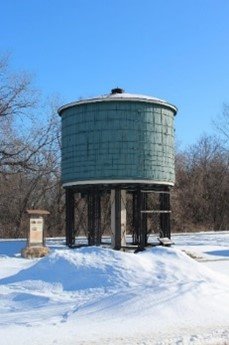 Wood was a common building material for early water towers, such as this reservoir in Carver, once used to refill the boilers of steam trains. (Photo: Kirk Brown, Minnesota Water Towers.) |
|
|
|
|
|
Most water towers these days are administered by municipalities (towns, cities), though some organizations (3M in Saint Paul or Hazelden Betty Ford in Center City) have their own water sources. Depending on size, most municipalities have one or more—sometimes many more. Water towers and other reservoir systems serve two purposes: first, to store water and, second, to distribute water by creating water pressure. Water towers are placed in strategic locations throughout Chaska. The facility is usually located at the highest elevation possible to provide maximum pressure at least cost of construction. Water is pumped to a specific elevation within water towers or tanks to provide pressure that pushes the water through the mains and into homes. The pressure ensures consistent access to water even at moments of heavy use. The pressure pushes the water through large pipes that branch off into smaller and smaller pipes until they finally enter your home. You’ve seen the effect: you turn on a faucet, and water comes out. Thanks, Local Water Tower! |
|
|
|
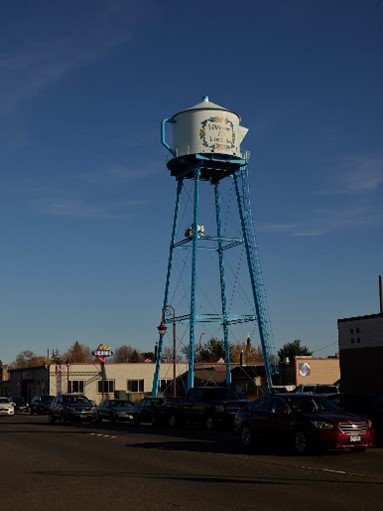 Many towns have whimsically designed water towers. A coffee pot with a hand-painted Swedish floral design tops the 1908 Lindstrom downtown landmark water tower, which reads “Välkommen till Lindström” (“Welcome to Lindstrom”). (Photo: Carol M. Highsmith, Library of Congress.) |
|
|
|
|
|
Chaska Water Tanks, Wells, and Towers Chaska has had numerous water systems. In the late 1800s, as a firefighting measure and because no central water system existed, a series of subsurface cisterns were placed throughout downtown. Firefighters pumped the water through hoses fed into the cisterns to douse flames. “Periodically someone was hired to refill the cisterns,” according to LaVonne Barac in Chaska: A River City. The first municipal wells were drilled beginning in 1936. The first wells had poor water quality, their water being full of iron and manganese. Other wells with better water quality were constructed, eventually replacing the older ones. Midcentury wells could pump about 500 gallons a minute. Wells that are still in use today can pump between about 800 and 2,000 gallons per minute. The deepest one taps into an aquifer—a water-retaining layer of underground permeable or porous rock, sand, or gravel—more than 800 feet deep. Aquifer Primer A well is drilled into an aquifer and water pumped out. Dale Setterholm, in the Geologic Atlas User’s Guide, says, “When pumping and discharge exceed recharge, the aquifer level begins to fall. This is like spending money faster than your income provides it—your bank account shrinks.” Aquifers are refilled through infiltration (movement of water from surface to aquifer) or recharge (movement of water below the surface). Sandier, looser deposits typically refill faster than clay deposits. Much of Carver County’s clay soil has low permeability (that is, it takes a long time for water to refill an aquifer). Parts of the Minnesota River valley have a relatively quick infiltration and recharge rate. |
|
|
|
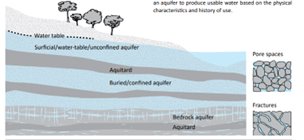 Porous or fractured aquifers are often sandwiched between moisture-resistant underground layers called aquitards. Image from Groundwater Atlas User Guide |
|
|
|
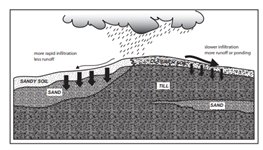 Water falls to Earth’s surface (right) and infiltrates the underground layers to refill aquifers. Image from Geologic Atlas User’s Guide. |
|
|
|
|
|
|
|
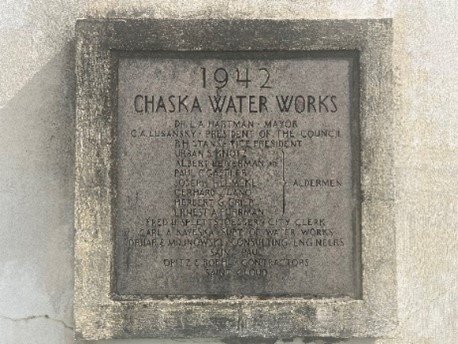
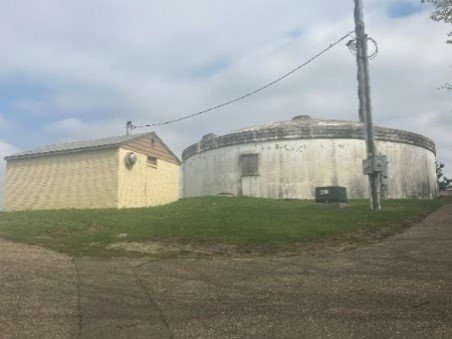
Chaska’s first structural water storage, a partially buried in-ground tank, was built in 1942. This Hill Tower Ground Reservoir was located “up the hill” above the Mount Pleasant Cemetery. Long-time Chaska resident Jerry Lubansky recalls being a college student in the 1950s, being part of the tank’s regular maintenance. After 2 days of draining the tank, someone handed Jerry a shovel, and he helped muck out accumulated iron and manganese sediment into buckets that were carried out and disposed. (Photos: Chaska Historical Society.) The most common type of water tower in Minnesota is a spherical type that looks like a golf ball on a tee. Constructed in 1966 as part of Jonathan, the tower located near Lake Hazeltine boasted a spherical shape to reduce wind resistance. It had a capacity of 300,000 gallons. The tower was decommissioned in 2013 because of increased maintenance costs. To help offset the loss, a 750,000-gallon water tower in the Symphony Hills area was erected to provide reliable water and fire protection in the area. The Hazeltine tower was salvaged, refurbished, newly painted, and installed in 2014 in the Village of Cameron, Wisconsin. Cameron Public Works noted that village water pressure would increase and residents should stay close to home as the tower came online. “You may develop leaks in your household piping. Faucets may start to drip, toilets may possibly leak. . . . Water hoses may burst due to age and water heaters beyond their service life may start to leak.” We may never know whether the dire predictions came true. |
|
|
|
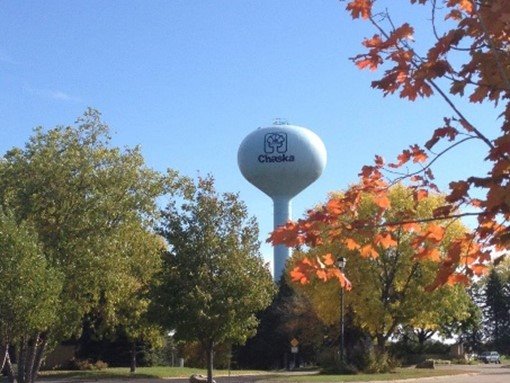 The Hazeltine water tower was decommissioned in 2013. When it was built, rumor had it that increased water pressure might blow people right off their toilets in downtown. The rumor was untrue, of course. (Photo: Matt Haefner, Chaska Water & Sewer) |
|
|
|
Later additions to the Chaska system of water towers addressed further population growth in Chaska. One constructed in northern Chaska, in the Jonathan Industrial park, holds 1.5 million gallons. As mentioned, the Symphony Hills tower supports 750,000 gallons. In 2002 the 1.5 million gallon tower near Clover Ridge Elementary School (also known as the Hundertmark Water Tower) was built to serve Chaska’s residents. |
|
|
|
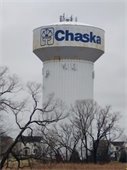 Chaska population expansions necessitated the 2002 construction of the Clover Ridge water tower. The tower progresses (left to right) through the 2022 repainting process. Repainting a water tower takes several months and costs more than $1 million. |
|
|
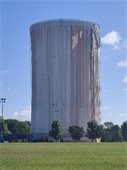 “Contractors must strip the tower down to bare metal, then begin the repainting process,” said Matt Haefner, Chaska’s Water and Sewer Director. |
|
|
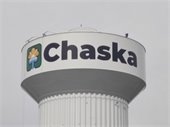 He added that water towers are scheduled for painting every 20 years. (Photos: Matt Haefner, Chaska Water & Sewer) |
|
|
|
More Chaska Water Facts
According to Matt Haefner, Director of Chaska Water and Sewer, Chaska manages a so-called clear well at the water treatment plant. This tank stores three quarters of a million gallons of water that has been filtered and disinfected. The water enters the distribution system when levels in water towers drop to a specific elevation. Altogether, Chaska Water and Sewer can treat 12.6 million gallons of water per day. Most of Chaska’s water system is underground and thus invisible—including the more than 150 miles of water mains that crisscross the city. However, evidence of the system can be seen around town: Numerous manholes provide access to the water mains, and about 1,600 fire hydrants poke their heads up around the community. Chaska maintains six wells, with an additional three planned for 2024. The wells range from about 300 to 800 feet in depth. The wells draw from four aquifers: Mt. Simon/Hinkley, Tunnel City/Wonewoc, Jordan, and Glacial Drift. Past, Meet Future
Chaska’s need for water has been ever increasing. The towering water reservoirs have played a critical part in aiding Chaska’s growth. They will continue to support the residents and businesses of Chaska far into the future. For assistance with this article, many thanks to Matt Haefner, Chaska Water and Sewer Director. Any errors of fact are solely the article writer’s. Learn More!
Barac, LaVonne E. (2019). Chaska: A Minnesota River City, Prehistory to 1950. Chaska Historical Society. Bauer, E. J. (2009). C-21 Geologic atlas of Carver County, Minnesota [Part A]. University of Minnesota Digital Conservancy. Cameron, Village of, Public Works Department. (2017). New Water Tower. Chaska, City of. (n.d.). Water & Sewer Department Spotlight. Chaska, City of. (2013, October 3). Let’s Raise a Glass to the Water Tower! Chaska City Hall Bulletin. Kraushar, Eric. (2022, April 13). Chaska City Council Reviews Reimagined Water Tower Design. SWNewsmedia. Lusardi, Barbara A. (2009). Surficial Geology [Carver County]. University of Minnesota Geological Survey. Meersman, Tom. (2013, October 14). Chaska Water Tower Will Be Demolished Because It Is No Longer Necessary and Is Too Expensive to Maintain. StarTribune. Minnesota Department of Natural Resources. (2021, March). Groundwater Atlas User Guide. MinnesotaWaterTowers. (n.d.). [Home Page]. Petersen, Todd A. (2014.) Hydrogeology of the Surficial Aquifer and the Buried Sand and Gravel Aquifers. In Geologic Atlas Of Carver County, Minnesota. Minnesota Department of Natural Resources. Reinan, John. (2019, November 2). Why Do We Have Water Towers and What Do They Do? StarTribune. Setterholm, Dale R. (2019). Geologic Atlas User’s Guide. University of Minnesota Geological Survey. |
|
|
|
|
|
Discover Your Roots with the Chaska Historical Society Genealogy SeriesBy Carrie Drephal Are you curious about your family history? The Chaska Historical Society is excited to announce our Genealogy Research Series, running from September 5, 2024, to March 20, 2025. This comprehensive series offers both expert presentations and workshops for individual attention designed to guide you through the fascinating journey of uncovering your ancestry. Series Schedule: - Presentations: Held on the first Thursday of each month from 6:30 pm to 8:00 pm.
- Workshops with an expert genealogist: Held on the third Thursday of each month from 6:30 pm to 8:00 pm.
Presentation Topics: - September 5: Getting Started with Genealogy (Free Session)
- October 3: Genealogy Goldmine: Insights from Vital Records
- November 7: Hidden Histories: Leveraging Census Records and Newspapers
- December 5: Borders and Benchmarks: Unearthing Immigration and Court Records
- January 2: Roots and Real Estate: Discovering Family History through Land Records
- February 6: Heroes Among Us: Tracing Family Military History
- March 6: Digital Discoveries: Navigating Online Genealogy Resources
The first session and accompanying workshop, "Getting Started with Genealogy," is free, but space is limited. Early registration is encouraged to secure your spot. Registration Information: - Individual sessions (Presentation with workshop): $20/person for non-members; $15/person for members.
- All presentation sessions with workshops: $100/person for non-members; $75/person for members
- Note: No refunds will be provided.
Register for individual sessions or the entire series to gain a wealth of knowledge from our experienced and professional genealogist. The registration form is available to download from our website, so secure your spot early! Don’t miss this opportunity to delve into your heritage with expert guidance. Join us at the Chaska Historical Society and start your genealogy journey today! |
|
|
|
|
|
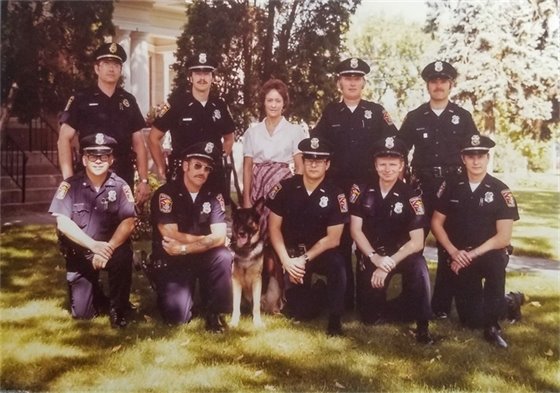
Chaska Police Research ProjectBy Ruth Travis Growing up in rural Minnesota, my perception of a Police Department was based on Sheriff Andy Griffith and bumbling Deputy Fife in Mayberry. Or the laughable antics of “Car 54, Where Are You?” Those TV show stories were not real. Real life were the earliest Village of Chaska Marshals and the night watchman who hand lit the street lamps, foot patrolled the “White Way” alone, and tended the burner on the fire department’s steam powered pump while his family and neighbors slept, trusting that he was on duty and they were safe. At the request of Police Chief, Ryan Seibert, our Chaska History Center has been asked to research the history and evolution of policing in Chaska as our community has grown from a township, to a Village, and was then chartered as the City of Chaska in 1891. Bill Johnson, Jayne Oddan, and I met with Chief Seibert on May 21st. It is his hope that we might unearth additional information, photographs, and archived objects that could be publicly displayed or perhaps used in creating interactive experience opportunities for visitors when the new Public Safety Facility on Engler Boulevard opens in November, 2025. And so, our research adventure begins! When first asked to consider this project, Chaska History Center Director, Lisa Oberski, searched the Carver County newspapers database. However, that database is inclusive only of articles that have been identified and linked to specific search words. Jayne Oddan is, therefore, presently combing through our earliest hard copy newspapers, particularly those that predate other archived sources. We were also given a compiled list titled “Police Chiefs, City of Chaska.” We now know it also is incomplete. In the initial steps of my research process in page-by-page skimming Chaska City Council minutes, I have found the appointments of 4 additional Chaska Police Chiefs who were not included, as well as additional errors. Compiling the names, dates, and personal information of record about these individuals brings them to light and honors their service to our community. In assistance to our quest, Dorie Coghill has searched Proficio for photos of our past Police Chiefs, but a very limited number were found. We know there are more photos out there. Bill Johnson is in search of the original sources used to incorporate photos of CPD Chiefs published in earlier writings and hopeful he may discover more. Bill is additionally researching the progression of Chaska’s Police identification patches and badges. We also readily admit our efforts may not lead to complete or definitive truths. Often, the “When and Why?” details of a transition in the Mayor’s appointment of a new police chief were not documented in the official City Council Minutes, nor reported to the newspaper. Sometimes certainly details were discreetly omitted for reasons we will never know. So, like a puzzle box we have opened in excited anticipation and begun to assemble, there have been and will continue to be disheartening moments when we realize certain pieces are missing. But we are committed to pressing onward and properly ordering the whole to the best of our ability. We look forward to sharing our progress along this journey with you, with Chief Seibert, and with our community. More to come! |
|
|
|
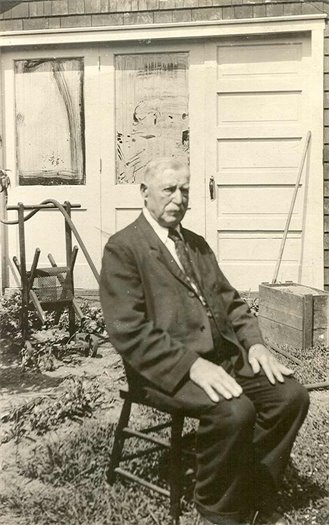 In 1891, Anton Bury was appointed Chaska’s first Police Officer, serving alongside the first Chief of Police, Thomas Powers. Later in the same year, Anton Bury was promoted to Chief of Police. Among his appointed duties: encouraging the payment of liquor licenses, notifying residents by order of the City Council not to throw straw and other substances into the streets, and house-to-house wellness checks during the outbreak of Diphtheria. Chief Bury also operated a meat market, the Merchants Hotel, and served many years on the Volunteer Fire Department. (Anton Bury photo dated 1900) |
|
|
|
|
|
Hauntings and Historyis a ghostly tour of downtown Chaska. Old towns with old buildings have a lot of stories to tell, some with ghosts drifting through the tales. The Chaska Historical Society invites you to a family friendly walking tour of the homes and businesses of downtown Chaska with spooky histories. Tours will take place rain or shine, lasting about an hour and a half and covering a walking distance of one mile. Wear some comfy shoes and prepare for a hauntingly good time! October 4 & 5, 11 & 12, and 18 & 19. There will be two tours nightly, the first at 6:30 pm and the second tour at 7 pm. Registrants should check-in at the Chaska History Center, 112 West Fourth Street, Downtown Chaska. There are two ways to sign up: 1. Online registration in the Chaska Community Center fall catalog 2. Follow the link on our website chaskahistory.org, which will take you to the Chaska Parks and Recreation registration website. The cost is $20.00/person. Sign up early, as space is limited, and tours were completely filled last year! |
|
|
|
Enjoying Learning about Chaska’s History?Few communities in the outer ring of the Twin Cities metro have the deep history of the Chaska area. From the burial mounds of Indigenous People in City Square Park to the heritage of the Dakota people from whom we get our name to the presence and industry of generations of immigrants and transplants, we have much to remember and celebrate. Here’s your chance to demonstrate your interest in and appreciation for the generous local band of individual recorders and sharers—our all-volunteer 501(c)3 non-profit Chaska Historical Society. We may not be carrying a kidney in a cooler, but we do perform a valuable service to the Chaska community! Let us know that YOU value the stories and deep roots of Chaska’s historic community! How? There are many ways to show your support: - Membership: Fill out the form on the “GET INVOLVED” tab of our website chaskahistory.org and pay for it online, by mail, or in person at the Chaska History Center, 112 West Fourth Street in historic downtown Chaska. Not only will you get the latest updates on our upcoming events, you will also learn about some of the other fascinating and community-supporting things we do from our quarterly digital newsletters! Besides, if you become a member, you automatically become a member in the Carver County Historical Society—a “twofer” benefit!
- Participation in Events: Learn more about local history and support our cause by visiting our free annual displays, or by registering for our historic tours, reenactments, and educational programs. From “Hauntings and History” to “Murder and Mayhem” to genealogy presentations and workshops, we’ve got lots to tantalize! Present display topics and upcoming events are noted on our website, often with direct links to registration.
- Shop: Check out our offerings online under the “GIFTS” tab of our website, and, to avoid shipping costs, stop in during the 1-4pm open hours on Tuesday, Friday and Saturday afternoons to purchase items! The prices of all items already include the tax, an added bonus. Items include books on local history and genuine Chaska bricks, of course, but also t-shirts, Chaska brick soaps and chocolates, cards and more!
- Volunteer: Share your time, your talents, and your resources by becoming involved with the society! Many opportunities abound, from staffing to helping with tours and other events to working behind the scenes with our collections and more. Choose your time, tasks and frequency (regular or variable), while contributing to a lasting, community-building investment. Applications can be found under the “GET INVOLVED” tab on our website or on site.
- Donate: Like most non-profits, we’ve always got more projects and needs than resources! Consider a tax-deductible gift in memory of someone you’ve lost, an annual or multi-year donation to support your favorite activities or ensure their continued presence, a legacy gift that preserves the history of the community beyond your lifetime, or even a donation of stock or other items we can use to build our endowment that guarantees our permanence in the community.
Chaska History Center, Open Tuesday, Friday and Saturday afternoons, 1-4pm
112 West Fourth Street, Historic Downtown Chaska. chaskahistory.org |
|
|
|
|
|
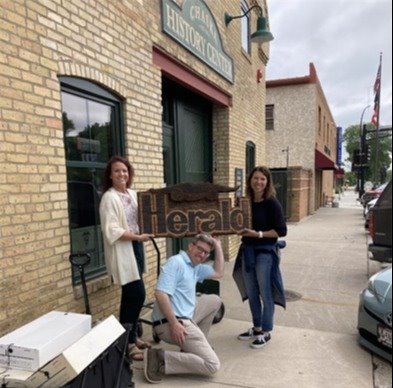
At the Herald's End...By Doris Coghill We were all sad to see the announcement that SouthWest Publishing was going to close down not only our beloved Chaska Herald, but also the newspapers from many of the surrounding communities. We were very glad to hear that as part of the shutdown they had assigned one of their longtime, dedicated employees to distribute any archives that they had in their possession to the historical societies of the towns/counties involved. So on one May morning a group of us converged on the Herald offices and loaded a pickup truck and another car with files, bound copies of newspapers, CDs, and envelopes full of photos and negatives. Part of the stash went to the Carver County Historical Society in Waconia and the rest to us. What a treasure trove!
A few days later Dorie spent the day sorting, and items she found that belonged to several other cities/counties were then distributed to them. Although the Herald gave us their photo and negative archives from the mid 1970s to the early 2000s in about 2005, they did not include any of the sports records or photos at that time. Sports memorabilia WAS included in this last batch. We are not sure as yet who will get the task of going through those three large boxes, but we are sure it will be a very fun project.
It will take us some time to go through the rest of the boxes and add those photos and archives to our collection, but it will truly be a labor of love. |
|
|
|
Mark Your Calendar Now for the 2024 Annual Meeting Program!
You won't want to miss this!
Join the Chaska Historical Society for a short romp through Minnesota History at our Annual Meeting on November 2, 2024. The Living History Society of Minnesota will perform a humorous play,19th Century humor, of Minnesota History in four acts. Audience participation may be encouraged (or expected).
The business meeting will begin at 9:00 am to be followed by the Minnesota History play at 10:00. |
|
|
|
|
|
|
|
|
|




 Share on Facebook
 Share on Twitter
 Share via Email
