Volume 5, Issue 2, May 2024
|
|
|
|
Food for Thought: What happens to your history when the primary source of recording your history ceases to exist?By Lisa Oberski, volunteer and board president Note: This short essay was sent to the Chaska Herald editor to be published in its last print issue on April 25, 2024, but was not included. Having recently finished leading the writing, editing, and publishing of the history book Chaska: A Minnesota River City, 1950–2000, I have a reawakened awareness of and respect for the importance of a local newspaper’s role in making and retaining a community’s identity and history. As I and other writers approached each of the topics in this latest book of written Chaska history, we primarily relied on scouring the Heralds from that time frame for the chronology of events and accompanying changes that unfolded as local decisions, both large and small, were made. In the Herald’s archives, we looked for connections that shaped our story, a story of the Chaska community’s experiences that could then be fleshed out through interviews and other research materials. This irreplaceable resource, with broad brushstrokes over the last 160-plus years, has painted a picture of how living in Chaska has changed during different eras. It provides the concrete details that serve as a framework for our individual stories and our community’s story. It is in these stories—our histories—that we construct and affirm our identity. It is also in our history that we are able to reflect on and learn from our past actions, allowing us to move toward positive change. Without the continued presence of those moments captured in the small bites of a weekly paper, I am concerned about our community’s ability to more accurately see multiple facets of past local events. I wonder if the more comprehensive overall story created by combining that carefully curated front-page headline with that page 7 two-line mention will be lost in the future, when the Google search turns up 25 million hits in which that two-line mention will be so buried—if it’s there at all—that it is lost. I worry that losing this opportunity to reflect on the variety of perspectives and interactions among factions will inhibit us from seeing trends that allow us to adequately and insightfully plan for our future. Will information be available online? Of course. But will that information be part of a centralized body, giving a more comprehensive view of a multitude of juxtaposed topics that work together in creating our community’s story? I’m not so sure. Without the depository of local information found in the good journalism that has characterized the written Herald over the last 160-plus years, researchers will definitely be disadvantaged when the second half of the next history book, Chaska: A Minnesota River City, 2000–2050, is written. |
|
|
|
A Benefit to the CommunityBy Julie Wiese, volunteer and board member Please don’t think of the Chaska History Center as being a dusty old museum hoping for visitors to saunter in and view artifacts behind the glass. Not at all. We are a vibrant and engaged part of the city, and we are needed. When the City of Chaska wanted information on old farms that were once located on the land that was designated for a new development, the history center provided it. When an architect requested photos of Guardian Angels school from the city, we found them in our photo archives. The library wanted to do a display on local fur traders in the area, and guess who dug up the history and even provided actual furs. We get out into the community. We go to schools, retirement communities, the community center and churches, telling the story of Chaska. If there is a community celebration, we are a part of it. Even in frigid December, we are giving horse and wagon tours of historic downtown Chaska. We also offer outdoor tours in the autumn called Hauntings and History, and, in springtime, a Murder and Mayhem in Chaska tour. Annual exhibits featuring different historical times of Chaska are created by the history center. We have lots of visitors and groups from middle-schoolers, home-schoolers, to county nurses—even buses from an Eden Prairie retirement community. Inside the history center itself is a wealth of information for the community. We are the keepers of all Chaska newspapers going back to 1862 and the guardians of about 4000 artifacts and 9000 photos. We have Chaska history books from pre-history to the year 2000, an obituary file, family histories, and connections to (and oral interviews of) village elders who have lived Chaska history. With all of this, the staff is well-armed to take on most inquiries. For instance, walking into the Chaska History Center, a woman wondered if a female ancestor of hers might be connected to Chaska history, and indeed she was. She was informed that her great- great- grandmother had been the town midwife for fifty years. We were able to show the visitor the pitcher and basin her great, great grandmother treasured, stories of her medical adventures, a photograph, and even connected her by phone to a cousin who lived in town. A grandpa called from New Orleans, wanting to prove to his grandsons that he had been a star baseball player in his high school years. The staff found a newspaper article from the early 1950s expounding on his baseball prowess and sent it to him. The man was delighted and sent us a large donation. A woman walked into the center asking for information about her mother. The woman had been adopted at birth and had never met her real mother. All she knew was her name, the town she lived in, and that she was deceased. A volunteer at the center was able to show her a picture of her mother in a Chaska High School yearbook. It was a very emotional moment for the woman. The volunteer also happened to know a good friend of her mother’s from high school and arranged a visit between the two. Later on, the woman wrote a gracious thank you note to the history center. To those who volunteer at the Chaska History Center, we know the center is an asset to the community, but we also know that many people don’t know we even exist, or if they do, they don’t know that we could be of use to them. Regardless, we keep on gathering our stories and doing our best to be a benefit to the community. |
|
|
|
|
|
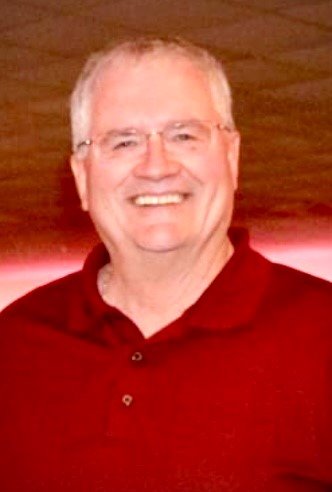
Chaska Historical Society Member Gregg DaviesBy Barb Van Eyll, volunteer and board secretary Davies, Davies; specifically Gregg… Where have I heard that name? Davies is an old Chaska name; when I think of Davies I think of the Teskes, remembered for milling in this community since 1928… Gregg grew up with his younger brother, Grant on the east end of 2nd Street in a unique log house. He shared a funny story (not funny at the time): One night, he and a couple of fellow teenaged pals were playing basketball in the driveway and enjoying a few beers. Not a smart idea, as one of his neighbors down the street, Blaz Leivermann, stopped by, who happened to be the town cop. You can probably guess how that story ended. Gregg graduated from Chaska High School in 1967; he is a member of the last graduating class from the “old high school” on East 4th Street. Gregg played football, made All-Conference in basketball (just might have had something to do with his height), ran track, and participated in class plays. He went on to attend the University of Minnesota-Duluth, but ended up having to leave in 1972 after his grandfather, Emil, suffered a stroke. Gregg’s mother Gay Teske Davies became the general manager of Teske’s Mill (she was one of the first female mill operators in the country), with Gregg as her assistant manager, until the mill closed in 1974. Gregg shared that it was during that time that he learned to cook. He was tasked with making meals for his Mom and brother. Gregg has fond memories of his mom, Gay. She opened their home to all of his friends and listened to their problems, was nonjudgmental and never shared with their parents. To this day, his friends still comment to Gregg how much Gay meant to them and the impact she had on their growing up days here in Chaska. Gregg is immensely proud of the influence his mom had on his friends and the community. During this time frame, Gregg married Kay and had 3 children, Brett, Jared and Rachael. Gregg, along with a few friends and fellow members of the Chaska Fire Department, had a booth selling various products at the Minnesota Renaissance Festival when it began its journey in September of 1971 on a 22-acre field in Jonathon. He followed the Ren Fest to the Shakopee site, opening a sweet corn, waffle and pretzel booth for the next 30 years. Ask him sometime about the stories he has about the elephants at the Renaissance or at a friend’s wedding he attended near Bemidji, Minnesota! In 1972 Gregg started volunteering with the Chaska Volunteer Fire Department. Why? Gregg was filling his car with gas at the Standard Gas Station when Bob Bleichner, the owner, asked him if he ever thought about joining the Fire Department. That suggestion from Bob, along with Gregg’s knowledge of the department from his father Doug, who had been a member in the 1950s, was enough to get him to join. Besides fighting fires, Gregg was also a trained EMT and went on many ambulance calls (The fire department ran their own ambulance service.). Gregg retired from the department in 1989, but one thing he remembers and values the most about his 17 years with the department is the comradery to this day with the other members, both active and retired. He joins a number of other retired firemen Wednesday mornings at the station for coffee, sharing memories and B.S.-ing. Gregg went on to work for Carver County in many capacities—Civil Defense Director, Interim Directors of Planning and Zoning, Human Resources, Environmental Services—and even oversaw the construction of an addition to the courthouse and jail. At the time, Dick Stolz was the Administrator and Gregg served as his assistant. It was during this time he married Jean Shively, who was appointed as Judge by Governor Arne Carlson. Jean had 2 children, Joanna and Daniel, from a previous marriage. Jean passed away in 2008 after complications from brain surgery. Gregg later started his own company, Project Planners which oversaw the construction of the Scott County Government Center, then went on to oversee projects in Hennepin County. After the floods in East Grand Forks, North Dakota, in April of 1997, his company oversaw the fiscal responsibility for the reconstruction of government buildings in that area. In addition to his contributions to the Chaska Fire Department, Gregg has also volunteered with the Chaska Cubs, the Chaska Community Fund, the Flags and Honor Organization, Chaska Emergency Operating Center, the 212 Medical ER when it first opened, the chain gang for the Gophers, and coached Chanhassen Football. He is still on the Chaska Historical Preservation Commission, involved with Christmas in May, the Community Foundation for Carver County and Chaska Area Fishing with Friends. Now does his name sound familiar? In his spare time, Gregg retreats to his year-round “cabin” on Moose Lake with his wife Laurie (Huepenbecker) Davies, whose name you should recognize also as she retired as the Carver County Auditor/Treasurer. Laurie adds her 3 children, Ryan, Brandon and Kelsey, from a previous marriage, to the Davies’ clan. Gregg enjoys fishing, hunting, scuba diving (which he learned in Cozumel and Belize), and golf. Gregg has been a member of the Chaska Historical Society since 2001. He became more involved when Tracy Swanson enlisted his help with moving the History Center into the present building in 2003. Growing up in Chaska and having a family connection to this community, he is a strong supporter of the organization. Gregg has been enjoying reading the new 1950 – 2000 Chaska history book and highly recommends it. For this recent publication, he was instrumental in providing information about the Chaska Fire Department between 1950 to 2000, but true to his modesty, he would like all to know most of this information had been documented by Dick Schalow, the Chaska Fire Department history guru, up until his untimely death in 1999. Gregg enjoys stopping by the history center occasionally. He’s always interested in what’s happening and usually ends up reminiscing with Tracy Swanson, Rick Engelhardt and Jerry Lubansky if they’ve stopped by. I remember one Friday afternoon in February when he and Bob Roepke, having just finished lunch, popped into the History Center to see a display of old valentines we had written about in our newsletter. Sorry Gregg and Bob—there was no actual display—but at least we knew people were reading our newsletters! |
|
|
|
Upcoming Events for Adults and YouthBy Lisa Oberski, volunteer and board president Were you foiled in your attempts to register for our tours “Hauntings and History” or “What?! Murder and Mayhem in Chaska?!” because they were already booked? Here’s your chance to reserve your place in upcoming events! We’ve got a couple of programs coming up that you’ll definitely want to check into. |
|
|
|
|
|
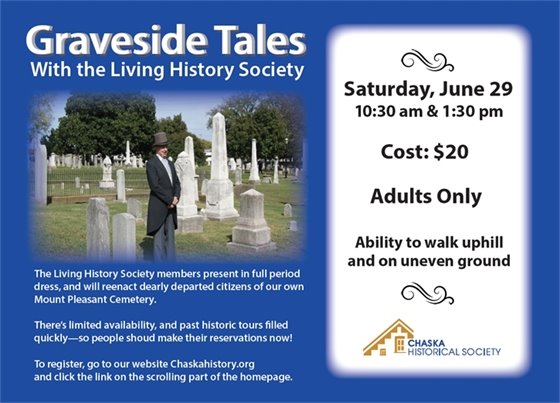
Graveside Tales
The first of these programs takes you on a tour through Mount Pleasant Cemetery, where you have a chance to learn about and ask questions of some of our dearly departed citizens. “Graveside Tales,” a collection of individuals’ histories, are presented by Living History Society reenactors in full period dress during two sessions on Saturday, June 29th. This program’s sessions, like the others mentioned above, are kept to a reasonable size to ensure that participants can adequately hear the presenters and interact with them. Pre-registration is required, and sessions are likely to fill quickly. Follow the link on the scrolling portion of our homepage to reserve your spot! |
|
|
|
|
|
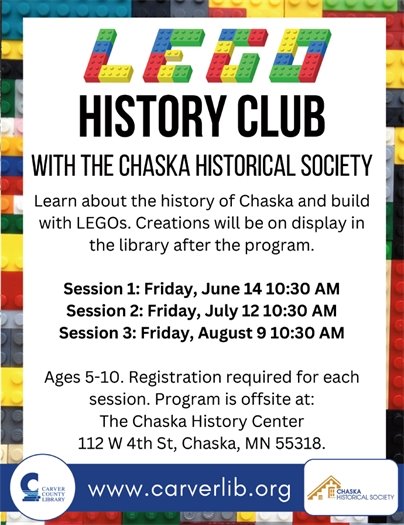
Lego History Club
Another program we have coming up is in partnership with the Chaska branch of the Carver County Library System. The “Lego History Club” introduces 5 to 10-year-olds to Chaska history by focusing on Chaska’s early brick industry! Participants will learn about the history of a variety of types of local buildings and be challenged to recreate them with LEGOs. Taking place in three sessions throughout the summer, this program will take place at the Chaska History Center, 112 West Fourth Street, and requires registration with the Carver County Library. Creations will be on display in the library after the program. For more information and to register, stop by the Chaska Library or visit their website. Hopefully we’ll see you at one of our upcoming programs! |
|
|
|
|
|
Volunteer OpportunitiesBy Barb Van Eyll, volunteer and board secretary The Chaska Historical Society is fortunate to have a group of talented volunteers helping to carry out our mission. Learning about Chaska history, developing new skills and contributing to the community are all aspects of volunteering at CHS. We are always looking for new volunteers. Reception Volunteer - Practice your friendly and helpful greeting skills in this position! Your primary responsibilities include answering the phone, greeting visitors and assisting guests as they research and view displays and explore Chaska history. Have limited knowledge of Chaska history? No worries! If you’re able to take messages, you’ll be fine! We will go through all of the necessary training for this position with you, and, to begin with, you will be partnered with one of our volunteers who has experience in staffing the front desk. This opportunity also can be paired with research or other tasks for when there aren’t many visitors. We have a strong need for volunteers to staff the front desk so that we can add consistent Saturday open hours. Events and Program Volunteer - Want to be involved but have limited availability? This could be the job for you! Let us know if you’re interested in staffing during special events or leading a program or tour! Some annual special events staffing opportunities include River City Days at the end of July, the Downtown Business Alliance’s Halloween candy handout, and Hometown Holiday the first weekend in December. Narrating the carriage rides during Chaska’s Hometown Holiday, assisting with historical tours like Hauntings and History or Murder and Mayhem, and presenting to scouting groups or others also fall under this purview. Don’t fret—you will be trained for all of the above-mentioned occasions and be accompanied by another volunteer as you learn the ropes. Archiving Assistant - Learn the ins and outs of our new collection managing software, Proficio. You will be trained to assist with one part of the archiving process. Working with our pictures, artifacts, and genealogical information of members of the community will allow you to also learn some of the history of Chaska. You will be trained by our IT specialists; they will be with you until you feel comfortable working on your own. Exhibit Assistant - Team up with other individuals interested in sharing Chaska's history. If you are available for shorter but intense periods of time this may be the job for you! Display topics need to be researched, written about, and physically created. Research is a huge part of putting together an exhibit. An artistic eye, problem solving skills, clear communication skills and working well with others are other necessary talents for this volunteer position. Other options? Absolutely! If you have other areas of volunteer interest, including marketing, video creation, oral interviews or more, please call us and/or fill out the volunteer application and indicate your interests. We’d love to have you contribute your time and skills to make a lasting difference! |
|
|
|
|
|
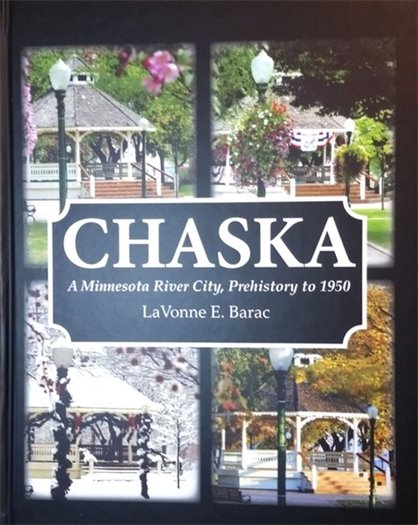
Continuing to Make Chaska’s History AvailableJeanette McGillicuddy, volunteer and board member We have good news and bad news. The good news? We’ve sold most of the 250 copies of the Prehistory to 1950 books that we printed in 2019—we presently have fewer than a dozen copies on hand! This valuable resource, with its comprehensive index, has been flying off the shelves lately as people invest in both of the volumes of Chaska history. We are at a point where we need to reprint this book of early Chaska history. The bad news? We have another daunting task ahead of us: raising MORE money for printing costs, hot on the heels of the huge printing bill for the recent 1950-2000 books. We need to raise funds both to cover the upfront printing bill and to ensure that the price of the printed book is not beyond the means of those interested in it. As it is, a price tag of $75 per book (rather than the $50 per book we were able to offer when we originally printed Prehistory to 1950) is highly likely, due to the increased costs of printing. To keep the book available and its price tag from rising to more than $75 per book, the Chaska Historical Society is applying for grants and looking for other means to facilitate the reprint. With these additional funds, we would be able to reprint the book and keep it and the recently published book, Chaska: A MN River City, 1950-2000, available for purchase at a more accessible price. These two books together provide the most complete history of Chaska to be had. If you have questions or wish to donate to the reprinting of the first book, please stop in during our open hours, or contact the Chaska History Center at 952-448-6077 or via email at historical@chaskahistory.org Thank you for your continued support! |
|
|
|
|
|
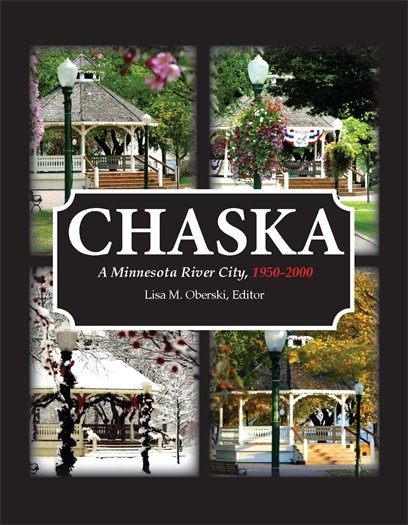
Our Thanksby Lisa Oberski, volunteer, board member, and editor of Chaska: A Minnesota River City, 1950-2000 Editor’s Note: As many people did not receive the invitation we sent to all members and individuals involved in the 1950-2000 Chaska history book creation, I thought I’d recap the presentation I gave. Please thank the individuals involved when you see them around town—they deserve it!—Lisa Oberski *** Chaska: A Minnesota River City, 1950-2000 takes the city of Chaska from - a population of 2,000 to nearly 18,000
- a physical area of ~3,700 acres to over 11,000 acres
- a time when the Jonathan New Town dream brought national attention to the community until it became one of the state’s largest homeowner associations (It is now the state’s largest.)
- being a rural community to being part of a metropolitan one
- a time when the risk of repeated flooding disasters was first experienced then eliminated
- an era when the emphasis of local business and industry changed from an agricultural service center to a technical and biomedical world
- an age when technologies changed rapidly with the beginning and advancement of the digital age
- an early to a revolutionized educational experience in everything from district structure to teaching techniques to curricular and extra-curricular offerings
- little to notably expanded opportunities for all youth in high school sports and other activities
- a tight-knit community to a time Chaska worked to maintain their close-knit sense of community
- …and more!
Since my name (Lisa Oberski) is on the book as editor, people will assume that I contributed a lot to this project. But I need to be honest about what I was actually responsible for. My part consisted of taking over the project leadership and process coordination when it was needed, researching and writing the education chapter, making all content additions and changes after writers completed their drafts, choosing images and writing the captions for them based on source materials, and responding to all of the layout and copyediting questions, suggestions and modifications. And, yes, it WAS a lot of work. But my contributions are only a PART of what made this book come alive. That’s the reason that I am listed as the editor, not the author, of this work. There are SO MANY other people who were involved in making this volume a reality. To begin, there were many volunteer researchers, writers, and editors. Mark Olson, longtime Herald editor, wrote significant parts of the 1950s and 1960s subjects, as well as the Foreword to the book. Prior to taking on the editorship of the Chaska Herald in 2002-2022, Mark set the stage for the eventual publication of the book by interviewing many individuals, researching a plethora of topics, and writing SO MUCH of the 1950s and 1960s material used in the book. Without Mark’s hours and hours of work, this book would STILL be in the drafting stage. In addition to giving us free rein to use any of his work, Mark, as editor of the Herald, granted us full use of the Herald archives, including photographs. And, as if that wasn’t enough, Mark was willing to write the Foreword to the book. His many contributions are immeasurable and greatly appreciated. Laurel Means, a retired college English professor, led the group of volunteer writers of the book (2017-2022) but also wrote large sections of 5 chapters (1, 3, 4, 7 and 8), and produced the first rough draft of the text before her death in 2022. As with Mark Olson, Laurel Means’s contributions to the writing of this work were significant. In addition to writing major sections of five chapters, as if that were not enough, Laurel was responsible for ensuring that the text, which had been written by many, sounded like one voice. Under her leadership, regular progress continued towards the finished book—though even with Laurel’s attention, the book was not completed in the one-year timeframe that she thought it would take. Laurel’s can-do attitude and supportive encouragement throughout the process, even after her cancer diagnosis and death, will always be remembered by those helping with this enormous project. Doug Munson, a local writer, researched and wrote Chapter 2, Historical Events. Unlike many of us who were a part of this project, Doug Munson came into the project with years of writing experience. He took our rather nebulous idea of what the Historical Events chapter should be about and was able to make the chapter (with its wide variety of disparate topics) work. In doing so, he was able to create a backdrop for local events that aptly put them into the larger context of national and international events. Nate Bostrom, former leader of Jonathan board and Jonathan resident, researched and wrote Chapter 5, The New Town of Jonathan. Interested in the entire Jonathan story, Nate provided background on “New Towns” and, as a resident and board member, took his insider’s knowledge of how Jonathan and the Jonathan board worked—and works—and made it come alive. The personality of the originators of Jonathan and of the “typical”—if you can say that—Jonathan resident come through in Nate’s chapter about this “New Town” phenomenon. Rick Engelhardt, Bob Roepke, and Tom Redman had significant contributions to Chapter 1, City Government and Chapter 7, High School Sports. Rick Engelhardt, sports enthusiast and dedicated historical society volunteer, took meticulous notes on high school sports in EVERY copy of the Herald between 1950-2000, and interviewed many significant athletes and coaches, which allowed for thorough coverage of the topic in the High School Sports chapter. Bob Roepke, in addition to MAKING much of the City Government history between 1984-2002, clearly articulated, in a way that no one else could have done, how the city’s changes during that time in history were methodically planned and implemented. His intimate knowledge of City Government is evident in the City Government chapter. Tom Redman, Parks and Rec director from 1975 to beyond the 1950-2000 scope of this book, provided well-written copy covering all aspects of Parks and Rec during his tenure, which fleshed out both the City Government and the Community Life and Leisure chapters. Eric Kraushar and Mollee Francisco, former Chaska Herald writers, brought much needed energy to organizing and finalizing the last two chapters: Chapter 7, High School Sports, and Chapter 8, Community Life and Leisure. Coming into the project at the very end, Eric and Mollee were able to take the draft writing piece of the last two chapters to the finish line, for which we are ever so grateful. Eric’s interest and expertise on high school sports, in addition to his skilled writing, were just what that chapter needed. Mollee, who had also done research earlier on Chapter 4, Industry, was able to rework the final drafts of Community Life and Leisure in a way that added to its readability and highlighted the connections that give Chaska its sense of small-town friendliness. In addition to the writers, we have the people behind the scenes supporting the writers—the people interviewed, our oral interviewer Kelly O’Neill, our oral interview transcriber Jill Metzger, and people who researched their stashes and memories for stories and evidence. …
Tracy Swanson, lead content editor, made sure there were no major omissions and that the material was as clear and as accurate as possible. With each new version of a chapter’s draft, we often walked the fine lines among what was enough, not enough, and too much information on a topic. She gently battled with me over the precise way to word something for clarity and readability with infinite patience and good humor. Tracy’s hours and hours of reviewing text and making suggestions guaranteed that I would not be solely to blame for inadvertent omissions or any wrong information. In addition to the 10-15 drafts of each chapter that Tracy reviewed tirelessly, she also provided endless amounts of research assistance. Tracy could come up with the answer—or the person who would know the answer—time and time again. She consulted the collection of topic files as needed, found items in the collection that provided needed evidence, and went through each edition of the fifty years’ worth of Heralds and the six years’ worth of Carver County Suns. In addition to the answers to particular questions found in the newspaper stacks, she pointed out significant photographs and articles that provided needed background or insight into various topics. Jerry Lubansky’s contributions on the city’s development as well as on small business and community life and leisure made the history come alive. As another content editor, Jerry’s amazing recollections of not only names, dates, businesses, and progressions of events, but also the emotions felt with those memories, made it possible to see, feel, and recognize the changes in the community and for its residents. And there were many others who proofed parts of the content for accuracy. Gregg Davies, Bob Lindall, Luke Melchert, Dave Pokorney, and Bill Johnson …are only a few of them. …
Those acknowledgements cover the writing of the text of the book. That step was followed by the selection of photographs and newspaper clippings, and the writing of the captions for them. Volunteer intern Daniel Scharfenberg and volunteer Dorie Coghill compiled digital files for most of these—around 1,000 digital files—so that they could be sent to Deb for layout. Many of those digital files were from our archives, but many needed to be created, whether by going through the stacks of newspapers and taking pictures of articles or by scanning photographs and documents. …
To take us through the last part of the process, we hired a few local skilled professionals, for whom we are also indebted to: Deb Frymet, layout specialist. Deb did the layout for the Prehistory-1950 book, and skillfully formatted this book to make them a matched set. Deb is not only skilled in design, she is detail-oriented, extremely easy to work with, and immeasurably patient. I don’t know how many times, without a word of complaint—to me, at any rate—that she changed the capitalization on various versions and parts of “County Road 61/Old Highway 212.” …and our copyediting team, Chuck Pederson, copy editor; Sandy Zilka, final proofer; and volunteer Marilyn (Savelkoul) Gahm, indexer extraordinaire. Under Chuck’s capable leadership, the copyediting team made the book as free from typos and clumsy sentences and misplaced commas and misspellings as we could have hoped for. Although the questions they raised often brought terror to my heart (usually because I was trying to resolve the issues without messing up the layout), this team undeniably clarified for readers parts of the text and the captions that I wouldn’t have even noticed needed clarifying. All this—and wonderfully responsive and pleasant to work with as well! …
But we are grateful to more than the team who put the book together, for the layout, copyediting and printing would not have been possible without the financial support of many: the city of Chaska, for its generous ongoing support of our mission; Rodney Forristall, a long-time supporter of Chaska history publications; the Chaska Lions, a consistent supporter of the Society since its inception in 1980; a Minnesota Arts and Cultural Heritage Fund Legacy Grant; the James Glatzel/Community Foundation; the Chaska Legion and Legion Auxiliary; the Chaska Veterans of Foreign Wars (VFW) and VFW Auxiliary; and the members of the Chaska Historical Society. As part of the Legacy Grant support by the Minnesota Arts and Cultural Heritage Fund, our gratitude is extended to CHS lead grant proposal writer Jeanette McGillicuddy, with writing assistance and critical reading from Wendy Petersen Biorn of the Carver County Historical Society and critical reader Chuck Pederson. …
Finally, there are so many people, mostly volunteers, who participated in, lived through, or shared their stories of Chaska (regardless of whether those stories were able to be included in the final version)—they made Chaska and this volume what they are today. Many thanks to all. Lastly, on a personal note, I need to express my thanks to the one who made it possible for me to devote my time to making the book happen—my wonderful husband Norm. Without his constant presence and emotional and financial support, I could not have brought this book to the finish line. Thank you, Norm. I love you. This book may be my gift to Chaska, but because of your support, it is also your gift to Chaska. ****
An additional editor’s note: My speech was followed by a presentation by Barb Van Eyll, on behalf of the Chaska Historical Society Board of Directors. Barb presented me a VERY unexpected surprise: A monetary gift that covered my plane ticket and some spending money for my recent trip to Japan. It was—and is—unnecessary but greatly appreciated. Thank you! |
|
|
|
|
|
|
|
|
|



 Share on Facebook
 Share on Twitter
 Share via Email
